

If you want to understand the wealth of the typical American household, the resources are excellent. Not only are there free public data sources, but there are also many great books that detail how people live across The Wealth Ladder. For example:
But the further you go up the wealth spectrum, the worse the data gets. Rich households are rare, hard to survey, and typically have their wealth tied up in illiquid, private businesses. As a result, there isn’t a great book that details the wealth of Level 5 ($10M-$100M) and Level 6 ($100M+) of The Wealth Ladder…until now.
It’s called The Everywhere Millionaire: Who Is Really Rich in America and How They Got There. It was written by Owen Zidar and Eric Zwick, two economists who did specialized research on how much tax American business owners pay. Because of this, they were able to provide insight into the wealth of the upper class and the superrich.
Technically, Zidar and Zwick focus on households with a net worth above $5M (the top 4%), but the average net worth in their data is $25M. This provides an incredible glimpse into what Zidar and Zwick call America’s “Main Street Millionaires.”
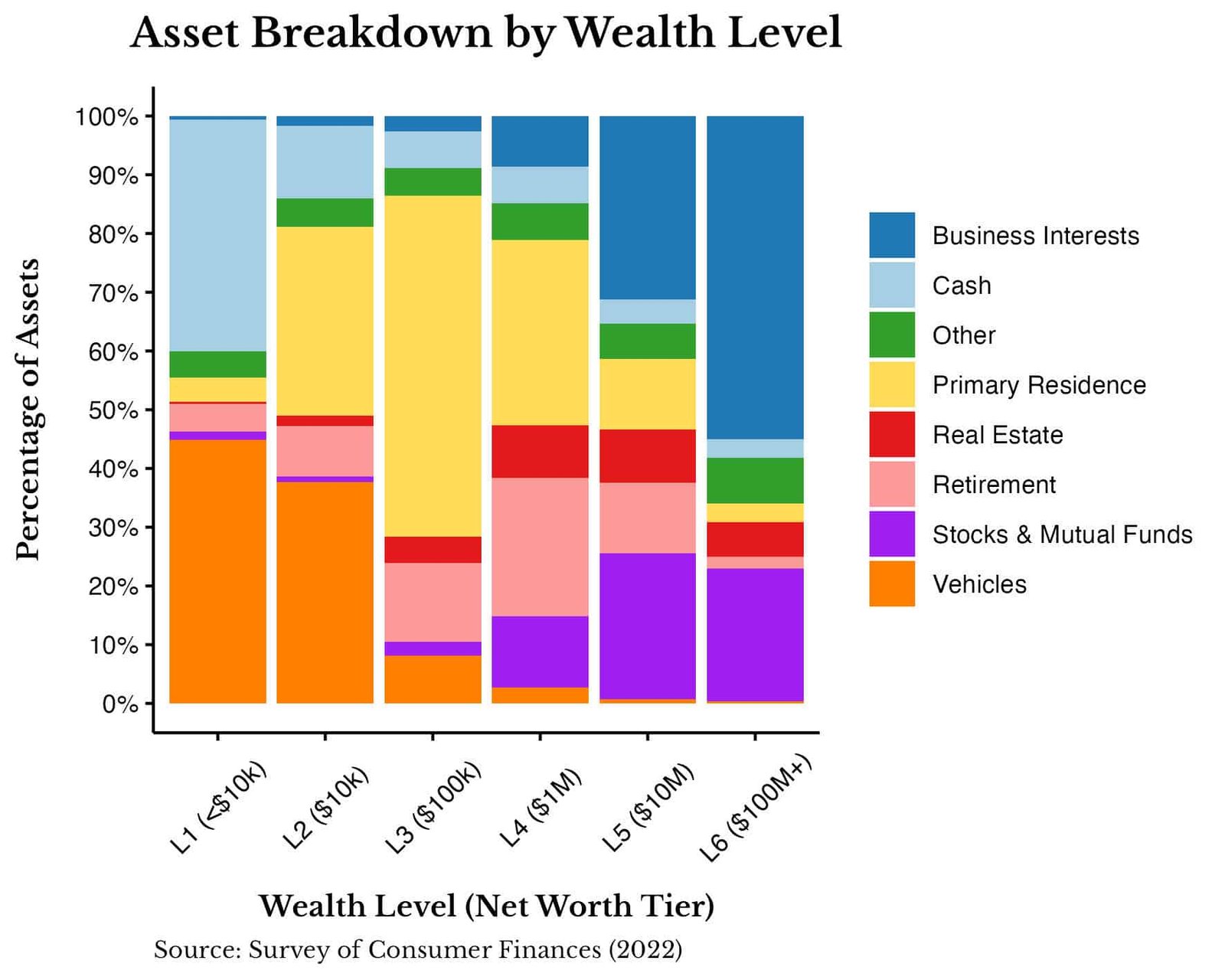
I already knew from my research in The Wealth Ladder that those in Levels 5-6 get most of their wealth from private businesses. You can see this in the chart below illustrating the asset breakdown by wealth level:

But what I didn’t know was the details. What kind of businesses? Who are America’s Main Street Millionaires? And how did they get there? This is where The Everywhere Millionaire comes in.
So let’s take a look at the upper echelon of American wealth, starting with the businesses that got them there.
What Kind of Businesses Do They Own?
When most people picture the rich, they think of people like Bill Gates, Ken Griffin, and Warren Buffett—tech founders, hedge fund managers, and longtime investors. These are the ultra-wealthy found inside the Forbes 400. But that’s not where most of America’s wealth is held.
According to Zidar and Zwick, Main Street Millionaires hold over 13x more wealth than the Forbes 400. And where do they hold it? In pass-through entities (like LLCs and S-corps) in various industries. Which industries in particular? Zidar and Zwick note that the top five are:
- Legal services. This is mostly law firm partnerships.
- Financial investment activities. This includes venture capital, private equity, and hedge fund managers.
- Auto dealers. These are the local, independently owned dealerships that sell new and used cars.
- Professional and technical services and management consulting. This includes independent consulting firms and other specialized professional practices.
- Oil and gas extraction. This includes fracking companies in North Dakota, Pennsylvania, and other states.
There are a few things to note about these industries (and the 20 others fully listed in the book). First, these businesses exist across the nation. You might need a lawyer, a car, or a consultant whether you’re in Nebraska or New York. Second, these industries aren’t dominated by a few megafirms. There’s no Amazon or Walmart of law firms or auto dealers. Instead, each has thousands of independently owned businesses that tend to make their owners wealthy.
This is why Zidar and Zwick call these owners “everywhere” millionaires. They aren’t located solely in Silicon Valley or Manhattan, but all across the United States.
But knowing where they are doesn’t tell us who they are. Let’s turn to that now.
Who Are America’s Main Street Millionaires?
The typical Main Street Millionaire is older, male, married, and White. Ninety percent of decamillionaire ($10M+) business owners are married, and their median age is 62. A lot of this is a function of time. Since it typically takes decades to build a successful business (especially at the decamillionaire level), Main Street Millionaires tend to be much older.
Additionally, the demographic breakdown of these business owners reflects who is more likely to found a business in the first place. According to Zidar and Zwick, men are twice as likely to start a business as women, and Asian and White individuals are 7x and 5x more likely, respectively, to own an employer business than Black individuals. And since White Americans make up the majority of the U.S. population, they comprise the majority of Main Street Millionaires as well.
But not everything about the Main Street Millionaires is based on demographics. One of the striking things about them is how educated they are. As Zidar and Zwick note:
Some 80 percent of decamillionaire business owners have a college degree, and 40 percent have a postgraduate degree (e.g., MBA, MD, DDS, JD, PhD).
These decamillionaire business owners are twice as likely to attend college and postgraduate school as the general population. But, interestingly enough, they’re less likely to go to college and graduate school than decamillionaires who don’t own businesses.
In other words, if you want to get rich, get a college degree or start a business. While most successful business owners have degrees, a degree seems to matter less if you own a business than if you don’t. I came to a similar conclusion earlier this year, so it’s great to see other researchers validate this with additional data sources.
Of course, all of these statistics describe the business owners who made it, not the many who tried and didn’t.
Now that we know who Main Street Millionaires tend to be, let’s see how they got there.
How Did They Get There?
Contrary to what you might expect, most Main Street Millionaire firms aren’t inherited. As Zidar and Zwick wrote:
In 2007, the most recent year for which the Census collected such information, 46 percent of all Main Street Millionaire firms were owned by the original founder, 32 percent by someone who bought it, 14 percent by someone who received it as a gift or transfer, and 7 percent by someone who inherited it.
Counting gifts and other family transfers, they estimate that the overall inheritance rate for these businesses is only about 25%. In other words, the vast majority of these businesses (75%) were not inherited.
But not inheriting a business isn’t the same as starting from zero. Statistically, founders are more likely to come from wealthy families. According to Zidar and Zwick, people from families in the top 1% of income are 2.4 times more likely to found a firm than those from families at the 90th percentile, and 4.1 times more likely than those at the median.
Yet most founders don’t come from wealthy families. Seventy percent come from families outside the top 10% of income, and a third come from families in the bottom half. How so? There are far more people in the bottom 90% than the top 10%. So while coming from a wealthy family increases the odds of starting a business, most founders are not from the wealthiest families.
Since family background only partially explains where entrepreneurs come from, what else does? Their first job, and, in particular, what industry their first job is in. Zidar and Zwick found that if your first job is in an industry that produces more entrepreneurs, then you’re more likely to become an entrepreneur. And if your first job is more entrepreneurial in nature (e.g., computer systems design, accounting, building equipment contracting), then you’re more likely to succeed as an entrepreneur.
That’s because your first job teaches you how an industry works and can help you develop a professional network that is valuable when starting a business. Zidar and Zwick estimate that these differences in early career experience explain 20% to 50% of the gaps in business creation by income, race, and gender. In other words, a meaningful part of why some groups start fewer businesses is that they’re less likely to get their start in entrepreneurial industries.
So, how did the Main Street Millionaires get there? Most built or bought their businesses (rather than inheriting them), and many got their start in the same industry where they’d eventually found their business. This is useful to know, but if you’re further along in your career, what does it mean for you?
What It Means for You
If the Main Street Millionaires can teach us anything, it’s that the path to great wealth runs through business ownership. You can get to Level 4 ($1M-$10M) with a good income, a good savings rate, and consistent investing. But the data suggests that getting to Level 5 ($10M-$100M) and beyond typically requires ownership.
You don’t need to start the business either. As Zidar and Zwick mentioned, about one-third of Main Street Millionaire firms were purchased rather than founded. Of course, buying a business requires resources, which take time to build.
This brings us to another key ingredient of being a Main Street Millionaire—time. Rome wasn’t built in a day and neither is a successful business. Don’t forget that the median age of decamillionaire business owners is 62. Unfortunately, there are no shortcuts in this game.
It’s also worth noting that for every business owner who became a Main Street Millionaire, many more didn’t. According to Zidar and Zwick, only about 5% of founders built a firm worth more than $5 million within ten years, and around half of firms stopped operating as stand-alone entities within five. Yes, this data suffers from survivorship bias.
At the same time, many founders who don’t strike it rich still land on their feet. Zidar and Zwick found that more than half of founders do just as well as their similarly situated, non-founder counterparts. Business failure doesn’t mean destitution.
And not starting a business doesn’t mean settling either. You don’t need to start a business to have a great life. You don’t need to be in Level 5 or 6 to be happy or fulfilled. But if this option appeals to you, then maybe you should consider becoming an Everywhere Millionaire yourself.
Special thanks to Owen Zidar and Eric Zwick for their incredible research. And thank you for reading.
If you liked this post, consider signing up for my newsletter.
This is post 522. Any code I have related to this post can be found here with the same numbering: https://github.com/nmaggiulli/of-dollars-and-data
