

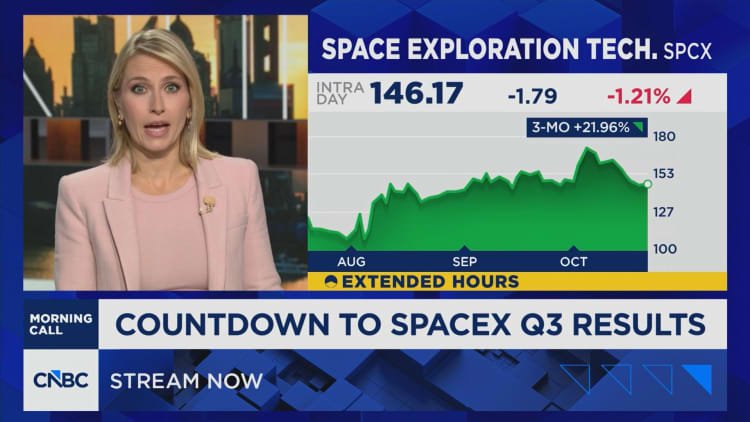

SpaceX shares climbed about 8% in extended trading on Tuesday after the company reported 161% revenue growth for the third quarter, beating Wall Street estimates, with its artificial intelligence business growing ninefold.
On the earnings call, CEO Elon Musk said a merger with Tesla, his automaker, would be a “good idea,” adding that the boards of both companies have formed special committees to discuss a tie-up. Tesla reports third-quarter results after the bell on Wednesday.
Here’s how SpaceX did compared to LSEG consensus estimates:
- Revenue: $14.58 billion vs. $12.72 billion expected
- Earnings per share: 45 cents adjusted vs. 13 cents expected
SpaceX said in a release that it recorded operating income of $2.8 billion and net income of $4.4 billion. In the same period a year earlier, SpaceX reported a net loss of $1.05 billion.
CFO Bret Johnsen said on the call that revenue in the first quarter of 2027 will be $33 billion to $37 billion, trouncing the average $22.2 billion average analyst estimate, according to LSEG. Johnsen attributed the forecast to “increased visibility into our compute contract pipeline over the next six months.”
While SpaceX is best known for its reusable rockets, most of its revenue and profit in recent quarters came from the company’s connectivity segment, which consists of its Starlink satellite internet service.
Starlink’s subscribers base grew to 13.6 million in the quarter, up from 12 million in the prior period.
Total connectivity revenue jumped 69% to $5.25 billion from $3.1 billion a year earlier. Analysts were expecting $4.84 billion, according to StreetAccount. Revenue from consumer Starlink subscribers amounted to $3.12 billion, while the company generated $2.13 billion from government and enterprise customers.
Buzz has been building about Starlink’s plans to build a U.S. mobile network after SpaceX, earlier this month, announced that it’s buying 800 MHz of low-band spectrum, and after the Federal Communications Commission approved a plan for the company to build out a 15,000-satellite constellation.
SpaceX jumped into AI with the purchase earlier this year of xAI, Musk’s AI lab. The company has been rapidly expanding that business by renting out capacity to Google, Anthropic and others.
AI, which SpaceX now calls “Super Intelligence,” has emerged as its largest business. Revenue jumped ninefold to $7.56 billion from $813 million in the same quarter last year. Analysts expected sales of $6.47 billion, according to StreetAccount.
During the third quarter, SpaceX also closed its $60 billion purchase of AI coding startup Cursor.
Meanwhile, SpaceX’s launch business was up just slightly in the quarter, with sales rising to $1.77 billion from $1.67 billion a year ago.
Almost all of SpaceX’s profit still comes from Starlink. Operating income in the connectivity unit about doubled to $2.37 billion. The AI business swung to a profit of $431 million, while the space division lost $7 million.
Between infrastructure, cloud deals and paying users of the Grok AI models and products, Musk said on the call that annual recurring revenue by the end of next year will be between $500 billion and $1 trillion. Analysts are projecting full-year 2027 revenue of about $110 billion, according to LSEG, which would be up more than 100% from this year.
