


Stealth startups are hard to track by design. Most have no website, no product page, and no announced funding.
The people building them are easier to read. Using CB Insights People data, we looked at a decade’s worth of AI 100-winning companies and identified 17 founders and founding team members who now list a role at a stealth startup.
Their past work leaves clues as to what they’re doing now. We used signals like work history, research publications, and social media posts to predict where these people — having built some of the most promising AI startups of the last decade — are placing their next bets.

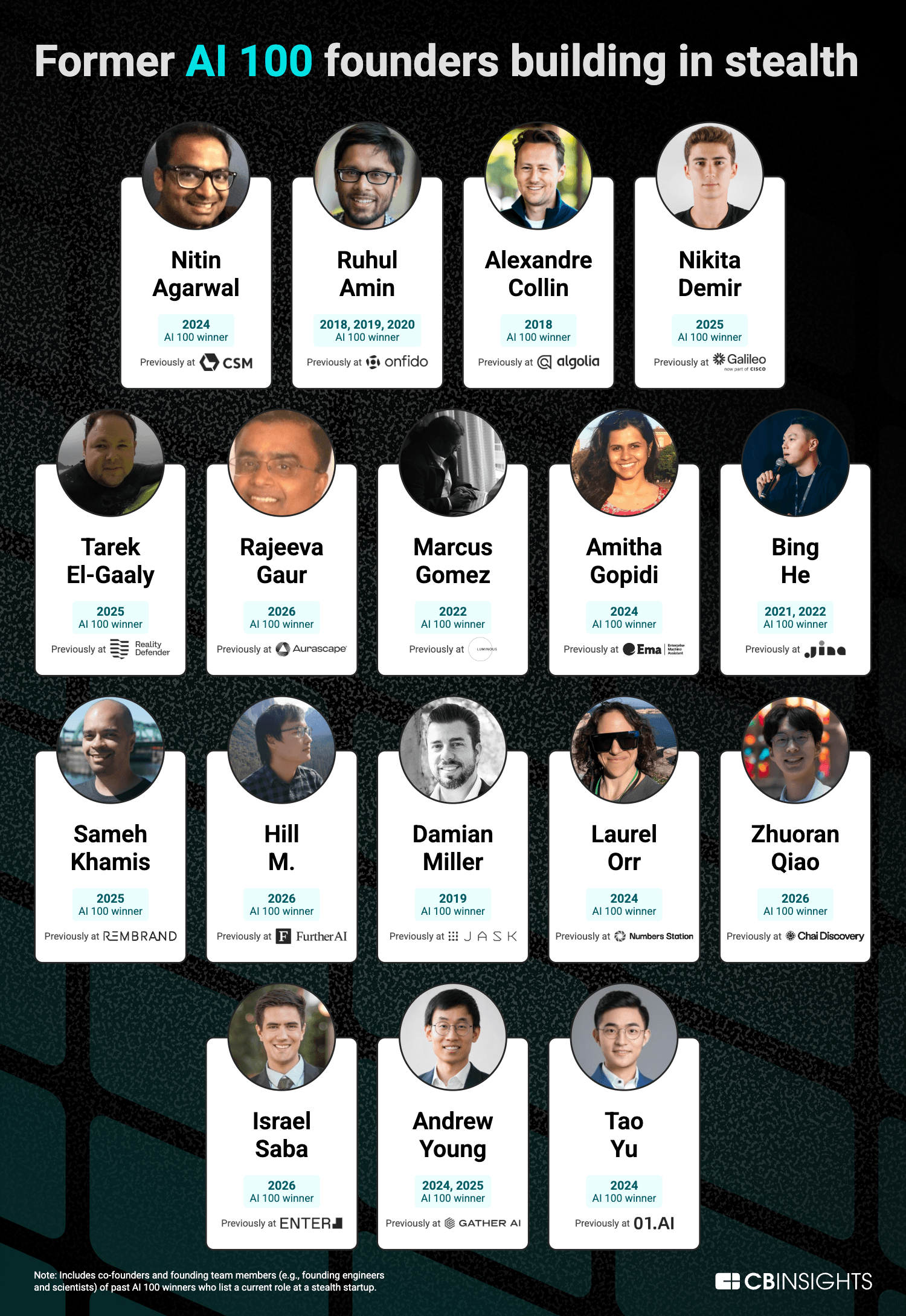
Note: Includes co-founders and founding team members (e.g., founding engineers and scientists) of past AI 100 winners who list a current role at a stealth startup.
CB Insights customers can see 4,300+ founders building in stealth here.
The founders and what they could be building next
The 3D AI researcher whose last startup was acquired by Google, now eyeing new uses for spatial AI
Nitin Agarwal
Agarwal joined Common Sense Machines as a founding research scientist in 2020 and led its 3D generative AI research from concept through production before the company’s acquisition by Google. He has listed a co-founder and CTO role at a stealth startup since April 2026.
Having helped build technology that converts images and text into 3D models, we expect Agarwal will apply generative AI to new spatial computing applications in areas like design, simulation, and interactive 3D environments.
The identity verification pioneer bringing his fraud-fighting expertise to a new market
Ruhul Amin
Amin co-founded AI identity verification company Onfido in 2012 and led its technical architecture and AI research. By its acquisition by Entrust in February 2024, the identity verification company had more than $140M in annual revenue and 1,200 customers. Since January 2026, Amin has been building a London-based stealth startup.
Although he’s kept current plans under wraps, his experience in identity security could position him to tackle emerging fraud threats in applications attracting growing startup activity, from AI-generated impersonation to authenticating autonomous AI agents.
Algolia’s 4th employee now building for real estate
Alexandre Collin
Collin joined Algolia in 2014 as its 4th employee and founding solutions engineer, helping scale the search and discovery company as it reached a $2.25B valuation in 2021. Over 12 years, he moved through engineering leadership, product management, and business strategy. Now building in real estate AI, Collin has publicly described work on DirectLayer, an AI-native platform aiming to shorten property searches through conversational search, agentic workflows, and automated document analysis.
Galileo’s first engineer could be taking on the next wave of AI model reliability
Nikita Demir
Demir was Galileo’s first employee and a founding engineer from 2021 to 2023, working across machine learning and product development as the AI evaluation and observability company emerged from stealth and raised $23.1M in funding. During his tenure, Galileo launched a platform to help developers identify and fix machine learning data errors.
At Stanford, Demir co-authored research using neural networks to detect elephant calls in noisy audio recordings, as well as a paper on improving ML models by fixing their training datasets. Based on his research and public discussions of data drift, mislabeling, and class imbalance, his stealth startup could be tackling a specific challenge in enterprise AI: keeping models accurate as the quality and characteristics of real-world data change.
The deepfake detection scientist whose latest research points toward embodied AI
Tarek El-Gaaly
El-Gaaly was a founding research scientist at Reality Defender, helping develop technology to detect AI-generated audio, video, and images. Before joining the company in 2022, he worked on machine learning and computer vision at Apple, Facebook, and autonomous driving startup Voyage.
Since joining a stealth startup as a founding scientist in April 2024, he has co-authored research on making AI agents more resilient to unpredictable real-world situations. Based on his research and a publicly listed affiliation with Second Nature AI (whose website now redirects to newly launched embodied AI platform Colosseums AI), he could now be developing AI agents that learn to navigate complex physical environments.
The veteran AI engineer tackling how autonomous agents perform at scale
Rajeeva Gaur
Gaur was a founding engineer and principal AI engineer at Aurascape, which develops AI-powered security technology. He brings roughly 25 years of software and AI experience, including more than 15 years in engineering leadership at Synopsys and work leading deep learning initiatives at Macy’s. He has been building a stealth startup since June 2025 focused on adaptive optimization for complex agentic AI systems.
After raising $114M for light-powered AI chips, this founder could be tackling another computing bottleneck
Marcus Gomez
Gomez co-founded Luminous Computing in 2018 and led the company as CEO, raising $114M from investors including Bill Gates and BoxGroup to develop AI supercomputers powered by silicon photonics. Under his leadership, Luminous built a 120+ person engineering team and completed multiple chip tape-outs.
In a 2024 paper published shortly before announcing his stealth startup, Gomez also explored the national security implications of advanced AI hardware, arguing that semiconductor supply chains and access to computing power are increasingly strategic concerns. While his newest venture’s focus remains undisclosed, the paper raises the possibility that his next venture will address AI computing challenges with national security implications.
After building enterprise AI agents, this engineer is helping bring automation into clinics
Amitha Gopidi
Gopidi was a founding engineer and tech lead manager at Ema, where she led development of AI agents for enterprise sales and recruiting. She previously co-founded Weka, a WhatsApp CRM used by more than 1K small businesses.
She has been a founding engineer at a stealth health tech startup since January 2026. She says it is piloting with two clinics and is working alongside two repeat founders with exits in consumer goods and health tech.
From scaling an AI search company across four cities to bringing AI into the physical world
Bing He
Bing He co-founded Jina AI in 2020 and served as COO, helping expand the AI search company across Berlin, San Jose, Beijing, and Shenzhen before its acquisition by Elastic. He developed open-source embedding and retrieval models, including models supporting 8K-token context windows.
Previously responsible for global strategic partnerships at Tencent Cloud, He has been building a stealth startup since January 2026 that he says is exploring agentic AI and hardware.
The researcher behind virtual product placement now teaching AI to understand physical spaces
Sameh Khamis
Khamis joined Rembrand as a co-founder in 2023, helping develop AI that inserts photorealistic products into video content. He previously worked on computer vision and 3D reconstruction at NVIDIA, Google, and Microsoft Research, including Microsoft’s Holoportation project.
Now co-founder and CTO of Halfpixel (currently in stealth mode), Khamis is applying that expertise to spatial intelligence technology designed to reconstruct, understand, and predict the physical world from images and sensor data.
The former Google engineer who could be applying his insurance AI experience to enterprise infrastructure
Hill M.
Hill was a founding engineer at FurtherAI, which develops AI agents for insurance back-office operations. Previously, he spent 7 years at Google working on distributed systems. He has listed himself as founder of a Mountain View-based stealth AI startup since July 2026. His last 3 work experiences have centered on tailoring AI to domain-specific uses, spanning manufacturing (UnitX), insurance (FurtherAI), and general business applications (Fractional AI). This consistent pattern suggests his next venture could focus on solving a persistent challenge: making general-purpose and frontier AI useful enough to address the specific needs of individual industries.
The cybersecurity veteran with a major acquisition behind him and AI-driven security in his sights
Damian Miller
Miller co-founded autonomous security operations company JASK in 2016 and served as chief security officer until its acquisition by Sumo Logic in 2019. He previously held leadership roles at McAfee and ArcSight, giving him experience across multiple generations of cybersecurity technology.
Miller has listed an interim COO role at a stealth startup since July 2024 and was also identified as CEO and co-founder of cybersecurity startup Supertide in June 2026. His continued involvement in cybersecurity ventures suggests his stealth company could also be tackling challenges in enterprise security, potentially using AI to improve how organizations detect and respond to threats.
The Stanford-trained ML researcher who could turn her enterprise data expertise toward AI agents
Laurel Orr
Orr was a founding engineer and head of machine learning at Numbers Station, which raised a $17.5M Series A led by Madrona Ventures before its acquisition by Alation, where she later worked as an AI staff engineer. As a Stanford postdoctoral researcher, she co-developed Bootleg, an AI system designed to recognize rarely encountered entities in text. More recently, she built a tool to examine how Claude Code uses context and external tools.
A founding engineer at a stealth startup since July 2026, Orr could be tackling a related challenge: helping AI agents identify and use the right tools and information without wasting context or overlooking useful resources.
From designing antibodies with AI to exploring the next frontier in molecular discovery
Zhuoran Qiao
Qiao was a founding scientist at Chai Discovery in 2025, working on zero-shot antibody design at the AI drug discovery company, whose partners include Pfizer, Eli Lilly, and Novartis. Previously, he developed NeuralPLexer models at Iambic Therapeutics and conducted doctoral research at Caltech.
Since January 2026, he has been co-founder of a stealth startup focused on frontier chemistry. In a recent LinkedIn post, Qiao said he is building foundational AI for chemistry spanning molecular design to manufacturing, and identified fellow co-founder Wenhao Gao, whose research tackles how to generate molecules that can actually be synthesized. The clues point to a focus on AI that connects molecular discovery with chemical synthesis and experimental testing.
From AI-powered litigation defense to a potential focus on securing AI agents
Israel Saba
Saba was technical co-founder of Enter, where he built its first AI-powered litigation defense product and helped recruit its early engineering team. The company attracted backing from Sequoia Capital and Founders Fund.
Since leaving in 2025, Saba has publicly discussed cybersecurity, AI governance, and deploying AI in regulated industries, including legal services and retail. His recent focus on securing AI systems, combined with his experience building enterprise AI products, suggests his next venture will focus on making AI agents safer to deploy in sensitive business workflows.
From AI-powered warehouse inventory to a $10M+ bet on autonomous agents
Andrew Young
Young was a founding engineer at Gather AI from 2024 to 2025, during which the AI-powered warehouse inventory company raised $17M in funding led by Bain Capital Ventures. He previously worked on TikTok Shop’s commerce platform.
Since launching a stealth startup in August 2026, he says he has raised $10M+ to build the next generation of AI agents.
The Google veteran and serial AI founder now focused on multimodal AI applications
Tao Yu
Yu co-founded 01.AI in 2023 and worked on training and alignment for its open-source Yi large language models. He also co-founded AI video company Akool as CTO and previously spent 7 years as a technical lead at Google. Since June 2025, he has been building another AI startup that he says is backed by top VCs and is hiring LLM and multimodal machine learning engineers, suggesting a focus on multimodal AI applications spanning text, images, and video.
If you aren’t already a client, sign up for a free trial to learn more about our platform.
