

Spending on AI infrastructure is now large enough to matter for the whole economy. Moody’s projects hyperscaler capex of $785 billion this year, approaching $1 trillion in 2027. The demand evidence is real. Microsoft’s AI revenue run rate reached $37 billion, up 123% year over year, AWS’s passed $15 billion, and hyperscalers added roughly $700 billion of contracted backlog over two quarters. Two cautions apply. Run rates of that size are small relative to annual spending of this magnitude. And much of the backlog growth comes from OpenAI and Anthropic, young companies whose ability to honor long-term commitments depends on continued access to capital. Demand forecasts that are both concentrated and dependent on external financing deserve a wide margin of error. Signs of softer demand growth, discussed below, add to the case for caution.
What History Shows
The pattern in past infrastructure booms is that the technology succeeded while many of the investors who financed it did not. Forecasts that the innovation would transform the economy were correct. The error was in the pace and scale of the buildout relative to the revenue available to service the capital.
Railroads are the classic case. Britain’s Railway Mania of the 1840s pushed share prices up and then down, leaving many investors ruined while the track stayed in place. In the United States, track mileage grew from roughly 30,000 miles in 1860 to about 200,000 by 1900, financed largely with bonds. Overbuilding contributed to the Panic of 1873, after the failure of Jay Cooke & Co., which was tied to the Northern Pacific, and to the Panic of 1893, when a large share of railroad mileage went into receivership. Earlier, the canal boom of the 1830s and 1840s left several American states unable to service the debt they had issued to fund canals, and some defaulted.
The telecom and internet build-out of the late 1990s followed the same script. Carriers laid fiber on the expectation that traffic would double every few months, and hundreds of billions of dollars were invested, much of it debt-financed. Only a small fraction of the installed fiber was needed for years afterward. Global Crossing and WorldCom filed for bankruptcy in 2002, telecom became one of the largest sources of high-yield defaults, and the Nasdaq fell about 78% from peak to trough. This was not just a U.S. phenomenon, as European carriers had also spent enormous sums with similar results.
A more recent case is U.S. shale. Producers spent aggressively through the 2010s, often outspending operating cash flow and relying on capital markets to fill the gap. Energy accounted for a large share of high-yield defaults when oil prices fell in 2015 and 2016, and again in 2020, even as consumers enjoyed lower gasoline and natural gas prices.
The academic evidence points the same way. In their 2005 paper, “Technological Revolutions and Stock Prices,” Lubos Pástor and Pietro Veronesi show that revolutionary technologies can produce rational but extreme run-ups in the stock prices of innovators because their future productivity is highly uncertain. Fama and French’s investment factor shows that firms investing aggressively have tended to earn lower subsequent returns than conservative investors. Rapid capital spending has not been reliably rewarded.
Early Signs that Demand May be Softer Than Assumed
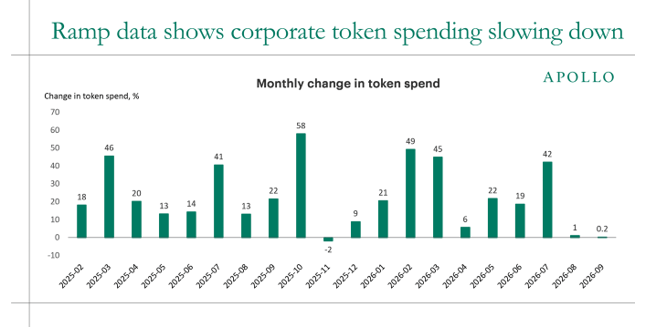
Torsten Slok, chief economist at Apollo Global Management, argues that the premise of unlimited demand for compute ignores price. He points to a recent slowdown in the growth of token spending as evidence that appetite for compute may be strongest when it is effectively free.
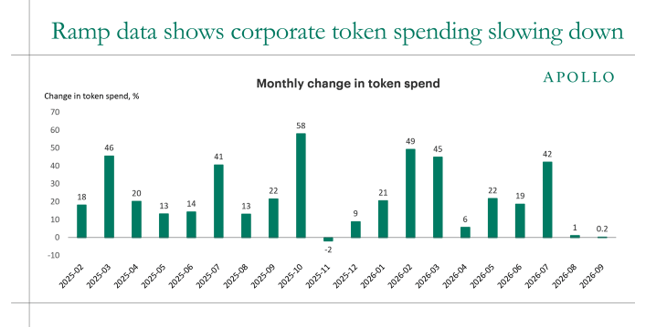
In his view, the demand curve for compute is flat and highly price sensitive. Modest changes in token prices lead buyers to lower usage or to substitute cheaper open-source models. The reason, Slok argues, is that productivity gains at companies using AI are arriving more slowly than projected, or not at all. That turns what was pitched as a growth engine into a cost center that squeezes margins. Companies will pay high prices for compute only if it raises revenue growth, widens profit margins, or cuts costs, and little of that is showing up at scale yet.
The supply side shows similar strain. According to Slok, return on invested capital for the five largest hyperscalers is declining because invested capital is growing faster than the earnings it generates.
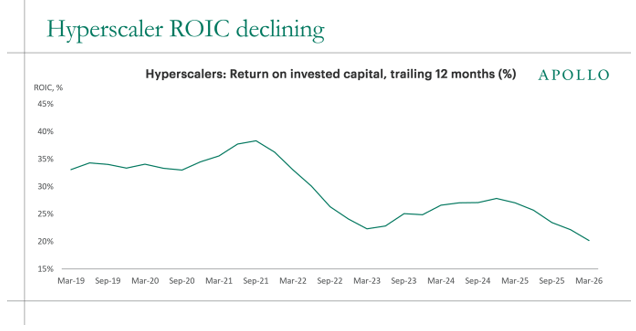
If producing compute is more costly than it is worth to users, the number of data centers needed depends on the returns firms can earn from compute, not on physical capacity or power. Whether those returns arrive later remains an open question.
This evidence is not conclusive. Slower growth in token spending is not a decline, and the backlog figures and the compute shortages reported above point in the opposite direction. Falling prices would also stimulate usage. The question for investors is whether the revenue earned per unit of compute, at the prices buyers are willing to pay, covers the cost of the capital used to build the capacity. If demand is this sensitive to price, each additional unit of supply pushes prices lower, and the benefit goes mainly to buyers.
Where the Risk Sits Today
The largest hyperscalers fund most of their spending with operating cash flow, which provides them with a cushion. However, that cushion is thinning as capex spending is eating into operating cash flow while debt and lease liabilities rise. The most exposed borrowers are those with the least cushion, and the market has begun to differentiate. For example, CoreWeave shares fell as much as 16% on Oct. 14 after yields on its bonds climbed toward 15%. The company carries more than $50 billion in debt, with yields on its 2031 bonds above 16% and credit default swap costs exceeding 1,100 basis points. Management pointed to a large contracted backlog as support for its obligations. The structural issue is a maturity mismatch: data center leases tend to run long while customer contracts may run shorter. GPUs also lose economic value faster than the debt that finances them amortizes. These are the conditions under which overbuilding converts into losses for lenders.
The exposed groups are equity holders and creditors of leveraged builders, lenders in the high-yield and private credit markets, and suppliers whose revenue depends on annual spending growth. Lenders in particular are paid a fixed return, so they gain nothing from a successful outcome beyond being repaid, and they bear the losses if demand falls short.
Who Gains if the Build Outruns Demand
Overbuilding creates losers among investors and winners elsewhere. Nobel Prize winner Robert Fogel estimated that railroads saved the U.S. economy about 4.7% of GNP in 1890 in freight costs relative to the best alternative, and the bankruptcies of the 1870s and 1890s did not undo the track. Cheap bandwidth left behind by the telecom bust, bought at pennies on the dollar by new owners, made video streaming, cloud computing, and remote work economical. Shale oversupply lowered energy costs for households and industry.
The same logic applies to AI. If capacity exceeds demand, computing prices fall, and customers across the economy gain access to more capability for less money. Productivity improvements flow to users such as hospitals, law firms, manufacturers, and ordinary consumers, regardless of whether the builders earn their cost of capital. Society can come out far ahead while the people who financed the build incur losses. The price sensitivity Slok describes is the channel through which this happens. Buyers who cut back at high prices or switch to cheaper open-source models are the ones who capture the gains when prices fall.
Investor Takeaways
Overestimating demand is one possible outcome, not a forecast. Demand could outstrip the capacity being built, and even then, history shows that a correct view of the technology does not tell investors how returns will be divided among builders, lenders, and customers. Market prices already reflect investors’ collective expectations, and no one knows which scenario will unfold.
Since the outcome cannot be known, the sensible response is to build resilience rather than to predict. A portfolio well diversified across sectors limits the damage if the build-out runs ahead of demand. Losses at leveraged builders, their lenders, and their suppliers would be partly offset by holdings in the many industries that benefit from cheaper computing and the efficiency gains that follow. Investors in market-cap-weighted index funds should check how much of their portfolio is allocated to the largest spenders, and those holding credit should check their exposure to AI-related borrowers.
