

(Bloomberg Opinion) — If you’re worried that an unraveling of the artificial-intelligence boom — whether because of overinvestment, circular deals, energy constraints, regulation or l’affaire Jensen Huang — will sideswipe your portfolio, I have a simple solution: the timeless, dependable 60/40 portfolio.
The classic portfolio made up of 60% stocks and 40% bonds is under siege as a growing number of money managers clamor to give it a makeover. Morgan Stanley’s Mike Wilson suggested last year that investors add a 20% allocation to gold. JPMorgan Asset Management recommended last month that investors allocate 30% to alternatives, mostly to private assets, real estate and commodities. Two recent surveys found that a majority of institutional investors and financial advisers want 60/40 portfolios to include alternatives.
The motivation is clear: Wall Street can’t make money on 60/40 portfolios assembled from a handful of low-cost index funds, but it racks up big fees peddling alternative investments. The problem is that institutional investors already have their fill of alternatives, so Wall Street needs fresh targets. Enter individual investors and their 60/40 portfolios.
Financial advisers have their own conflicts of interest. Investors don’t need to pay management fees for a simple portfolio they can construct with help from an AI bot. But a chatbot can’t open the door to the latest exclusive investment in AI startups or data centers or uranium and copper. Many investors are also anxious about the broader environment — inflation, rising interest rates, regional wars, asset bubbles and now AI-related scandals. Alternatives are no more insulated from these risks than traditional stocks and bonds. But without a public market constantly spitting out prices, investors can pretend that they are.
The potency of a 60/40 portfolio, however, is as underappreciated as the benefits of alternatives are overstated. The origin of 60/40 is something of a mystery. I’ve heard many stories over the years, most commonly that because stocks have a higher expected return than bonds, it makes sense to tilt an equally weighted portfolio in their favor. Whatever its origins, the strategy has endured for good reasons.
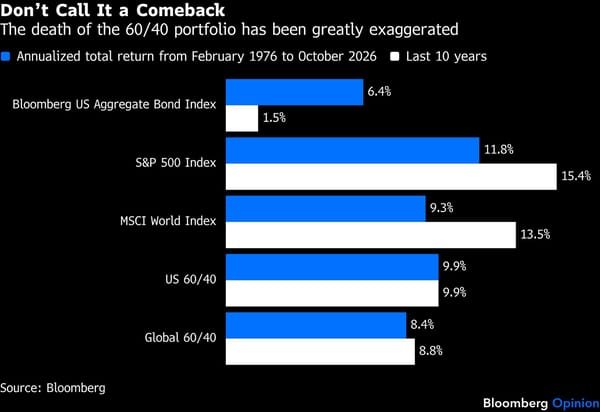
Chief among them is that 60/40 portfolios have been outstanding performers historically, delivering nearly stock-like returns with roughly a third less volatility. A portfolio allocated 60% to the S&P 500 Index and 40% to the Bloomberg US Aggregate Bond Index has generated a total return of 9.9% a year since 1976, the first year for which returns for the bond index are available. On a risk-adjusted basis, 60/40 handily beat both stocks and bonds alone.
A more international portfolio that substitutes the MSCI World Index for the S&P 500 would have performed nearly as well, even though stocks outside the US had a rough go for much of the time since the 2008 financial crisis. Still, the more global 60/40 portfolio returned a respectable 8.4% a year.
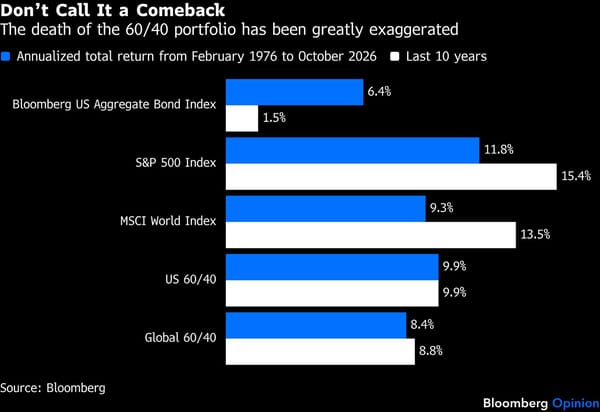
With so many people looking to rejigger the 60/40 portfolio, one might think its best days are behind it. Not so. It has performed as well or better over the past 10 years despite fierce headwinds, including record low interest rates, a historic surge in rates, a global pandemic and a bear market for tech stocks. Nevertheless, the US-based 60/40 matched its long-term return of 9.9% a year, while the global 60/40 bested its long-term average, returning 8.8% a year.
The 60/40 portfolio also makes intuitive sense for passive investors because it roughly tracks the relative market value of US stocks and bonds. The exact stock/bond allocation might move modestly depending on which stocks and bonds are included and how much of the world the portfolio covers, but 60/40 won’t be terribly off target. And it’s cheap and easy to own. Just open an account at any major brokerage and buy one or two low-cost index funds that track broad stock and bond markets.
Now here’s the dirty secret: Adding alternatives is more likely to be a drag than a boost. Institutional portfolios are stuffed with alternative investments, the same ones Wall Street wants in 60/40 portfolios. State and local pensions had an average 35% allocation to alternatives in 2025, roughly in line with their allocations in recent years. The results have been underwhelming. US public pensions returned 8.2% a year on average over the 10 years through 2025, trailing both US and global 60/40 portfolios.
US college and university endowments fared even worse despite having more than half of their portfolios in alternatives on average. Some of the largest endowments reported huge returns last year on early stage investments in SpaceX and AI-related companies. Those headline-grabbing gains haven’t translated into strong aggregate performance. As a group, endowments returned just 7.7% a year over the same 10-year period.
No matter how well 60/40 performs, investors can count on Wall Street pushing alternatives into the mix — even though those alternatives are unlikely to make them any more money.
To contact the author of this story:
Nir Kaissar at [email protected]
