
Vertical AI companies are starting to look more like research labs.
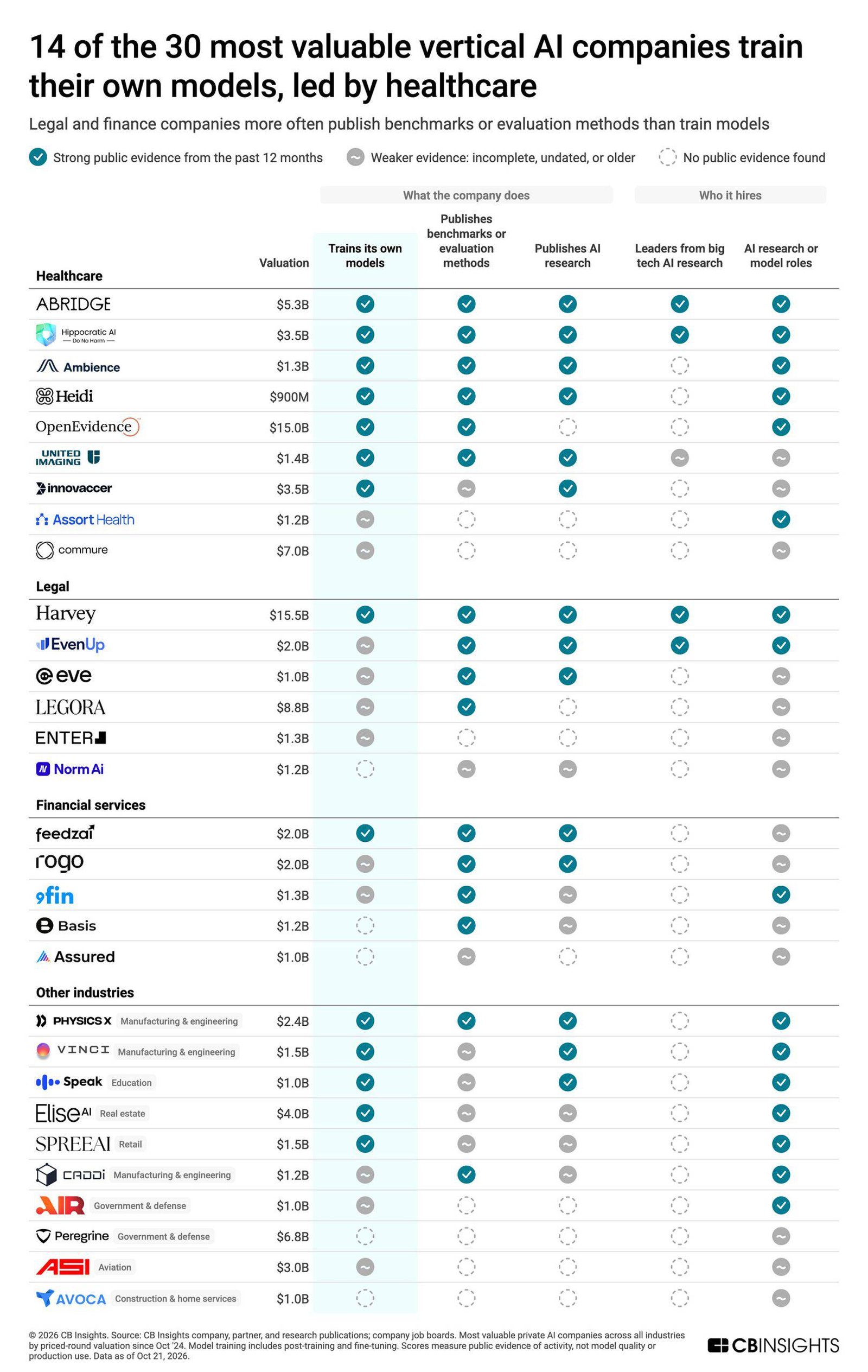
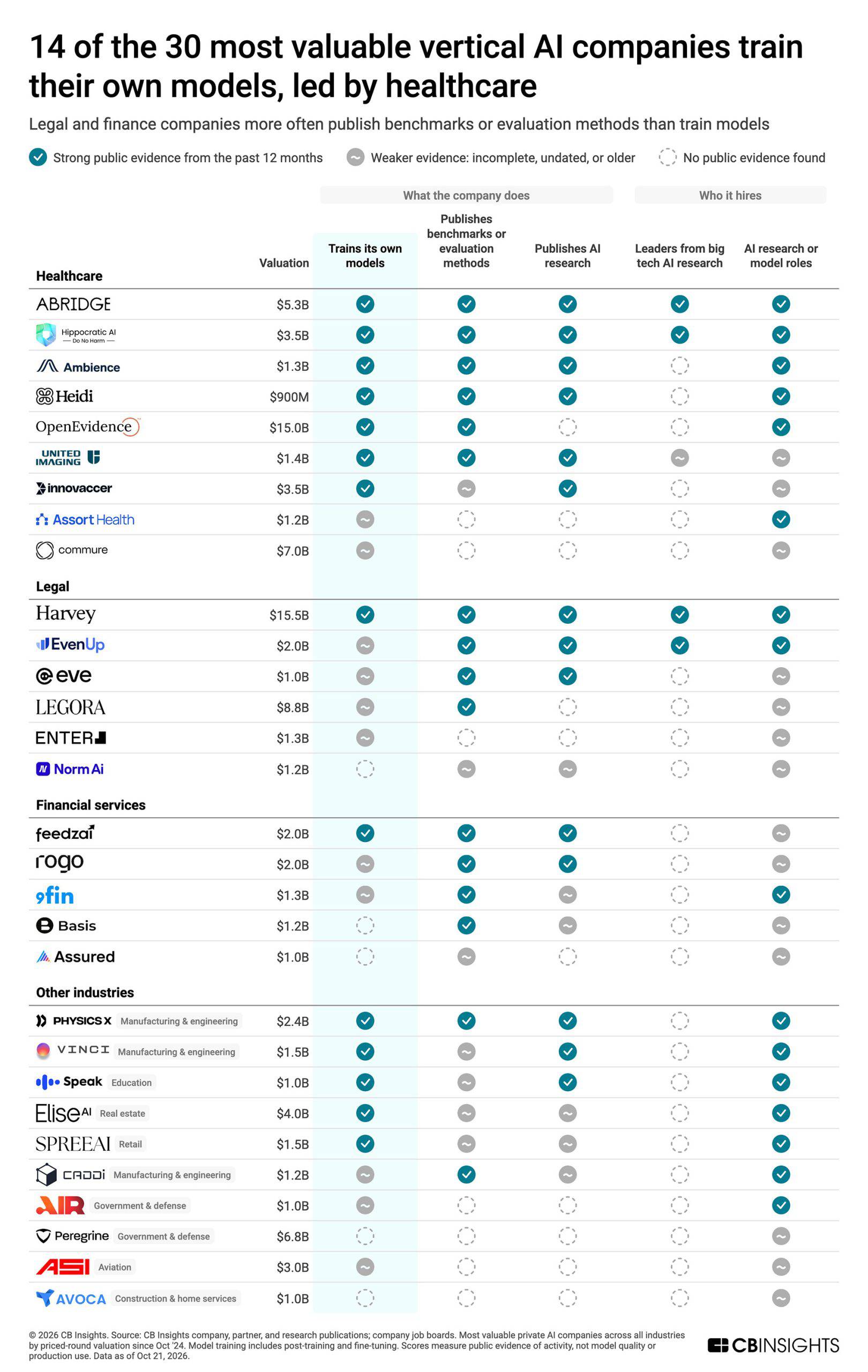
We looked at the 30 most highly valued vertical AI companies and found that nearly half (14) publicly disclose they now train their own models. They do it mainly by taking an existing model and training it further on a narrow job: catching drug names in a doctor’s dictation, answering a clinical question, working through a multistep legal task. The goal is fewer errors or lower costs on the work their customers repeat most.
In legal AI, for instance, Harvey’s first trained model, Tenet, costs less than a quarter as much to run as leading AI models and ranks #2 in performance (albeit on Harvey’s own legal-task benchmark). Cheaper, more efficient models will pay dividends as Harvey and others see surging AI usage among customers.
Training models is just one of the five research capability signs we analyzed among the cohort. We also looked at whether they publish benchmarks or evals; publish AI research; bring in talent from big tech AI research; and whether they’re actively hiring for AI research or model work.
Three findings stand out from our analysis:
- Healthcare leads, with seven of nine companies training their own models. We think clinical data and access to expert reviewers explain much of the lead. Patient-facing AI developer Hippocratic AI, for one, has trained speech models to handle clinical phone calls. CB Insights analysts rate it Optimistic, in part because owning its models lets Hippocratic tailor its product in ways rivals relying on general-purpose models can’t.
- Legal and finance AI companies write tests more often than they train models. Eight of the 11 featured here publish their own benchmarks or evaluation methods. Only two, Harvey and Feedzai, have described training a model in the past year. A good test is what lets a company choose among outside models and prove whether training its own would pay off. AI finance analyst Rogo, for example, had finance practitioners write the 928 questions in its benchmark. Establishing itself as an expert in model evaluation and routing has helped Rogo make inroads into the banking sector, including now having 9 banks on its cap table, while its ARR has more than tripled since the start of 2026.
- Seven companies exhibit at least four of the five signs of being a research lab, and four of them are in healthcare. All seven publish research and tests and hire for research or model roles. Harvey, Hippocratic AI, and clinical documentation company Abridge show all five. The score counts public activity, so it measures how hard a company is investing in research, not how good its models are or how well it competes.
Harvey built the test first, then the model
Harvey is the clearest case of a company moving from testing models to training one for its own needs.
In May, it published Legal Agent Bench, its own benchmark of multistep legal tasks. In August, it released Tenet, a research preview built by further training Kimi K3 from China-based AI developer Moonshot AI.
Harvey structured Tenet’s training tasks like the ones in Legal Agent Bench and held back separate tasks to test the result. Legal experts wrote the tasks and grading rubrics. The training data mixed public legal material, AI-generated examples, and expert contributions.
Harvey reports that Tenet placed second on Legal Agent Bench at under a quarter of the cost of leading models. Both results come from Harvey’s own test, which is why buyers will want to see Harvey’s AI hold up on their own work.
The cost edge matters because AI providers charge by the token, and Harvey runs through a lot of them. Monthly usage on its platform rose from 1T tokens in January 2026 to 14.6T in June, according to investor Lightspeed. Those volumes predate Tenet, but they show how quickly a cheaper legal model could pay off.
Harvey is leaning on M&A and hiring to keep momentum going. In September, it acquired Guardrails AI, which makes testing tools for AI agents, and in October it was hiring a post-training research engineer.
We think Harvey’s advantage rests on having its own tests, expert graders, and a research team that keep improving legal work and lowering its cost as the labs’ models change underneath it.
What to expect next
- Labs and platforms will keep supplying vertical specialists while competing for their customers. In legal, OpenAI launched products for legal and finance work in September, and its legal launch included Harvey and Legora as API customers. It also gives law firms tools to build their own workflows. Healthcare specialists face similar pressure from the systems they integrate with. In February, Epic, the largest US health records provider, made its own ambient documentation tool broadly available to its customers, which puts it up against the scribes that integrate with Epic, including Abridge and medical scribe Ambience. We expect specialists to keep building on labs and platforms while developing their own edge on narrow industry tasks.
- More legal and finance specialists will move from testing to training. Legora, the second most valuable legal company in our analysis, has made further training of existing models part of its strategy, and debt data provider 9fin has advertised a role to do the same with its data. With eight of 11 already running their own benchmarks, most of the groundwork is in place.
How we built this
We used the CB Insights MCP to filter for vertical AI companies, then ranked them by their latest priced-round valuation (since October 2024) and scored the top 30 on five signs of AI research capability: model training, published tests, published research, leaders from big tech AI labs, and research hiring.
For information on reprint rights or other inquiries, please contact reprints@cbinsights.com.
If you aren’t already a client, sign up for a free trial to learn more about our platform.
