

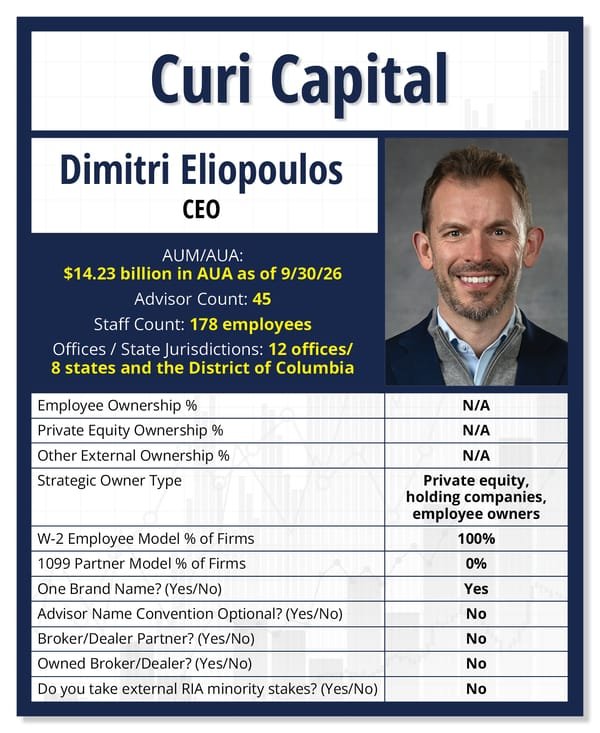
In 2023, Curi Capital, a Raleigh, N.C.-based registered investment advisor with $14.23 billion in assets under administration, made a serendipitous acquisition. It acquired RMB Capital, a Chicago-headquartered RIA, where Curi Capital CEO Dimitri Eliopoulos spent nearly 15 years following its inception in 2005. He took the CEO position at Curi Capital in early 2020.
In the last three years since that deal, Curi Capital has focused on integrating the two firms and developing a new 10-year plan. Now that that work is behind them, the Curi Capital team has turned to focus more on intentional growth in 2026. To support that next phase, Curi Capital decided to raise capital, taking investments this year from Wealth Partners Capital Group and, more recently, from Vistria Group, a private equity firm.
But Eliopoulos is a big believer in employee ownership, and by the end of this year, 100 of Curi Capital’s 180 employees will own stakes in the business.
Wealth Management recently spoke with Eliopoulos about the firm’s roots, cap table and plans for M&A.
The following has been edited for length and clarity.
Wealth Management: Would you provide a bit of the firm’s history and your background?
Dimitri Eliopoulos: My experience over the last 24 to 25 years is a representation of how I think our industry has evolved. I started as an intern. I was a part of a team that was, at the time, inside PaineWebber, which was acquired by UBS in 2001. In 2005, our small team of 12 or 13 people resigned, and we started an RIA called RMB Capital. I’ve really learned this business from the bottom up, and it’s given me a great appreciation for what different areas of the company do to ultimately serve the client.
When we started RMB Capital in 2005, we had $500 million of client assets. We brought over close to 100% of our business from UBS. And over the years, we grew largely organically and did do some opportunistic acquisitions. Fast-forward to 2018 and 2019: I was the president of the wealth management group, which meant overseeing the client experience and our advisor teams and advisors. My family and I were born and raised in Chicago. We had never left Chicago, and this opportunity presented itself to become CEO of what was then a startup called Curi Capital. We took a leap of faith, and my wife and I, with our three little daughters, relocated to Raleigh, N.C., and I was part of the starting team that launched Curi Capital. From 2020 to 2023, we grew it to 20 employees, 500 clients, and about $1.7 billion in assets. Proved the concept. We were largely focused in the Southeast.
Our one large investor, Curi Holdings, has an affinity for serving physicians, so that was part of our niche initiative to help the healthcare community, which we did and still do. And then, serendipitously, I found out that the founders of RMB had started a process to find a strategic partner, and we were included in that process. And on Jan. 1, 2024, Curi Capital acquired RMB, and we merged the two together as one RIA. One of the reasons was succession for the original founders.
We spent the first couple of years very focused on integration of the tech stack, all the systems, creating a new 10-year vision and plan for the firm, making sure people were in the right seats, figuring out where we were going to deploy investments and resources, really setting up a foundation so we can then eventually turn the calendar and focus on growth more intentionally, which is what we’ve started to do here in 2026.
WM: What’s the history of the firm’s ownership structure?
DE: I am a huge believer in employee ownership as part of that cap table. So originally the RMB business had two owners, and then that began to expand somewhere around 2010, 2011. Slowly but surely over the years, more and more employees were invited into the ownership and the partnership. When I helped start Curi Capital, we had very few employees, but there were close to a dozen or so who had ownership. Curi Holdings came in and was the majority owner of Curi Capital. And then a few months ago, we decided to take on new strategic ownership. The Vistria Group, a private equity firm, is our new majority owner. Curi is still an owner, but they’re a minority investor. Wealth Partners Capital Group, which is a premier M&A partner in our space, is also a minority owner.
Then the rest of the ownership is held by employees. Today we have a little more than 180 employees, and by the end of the year, over 100 employees will have ownership in our business. I’m a big believer that organizations are there to create value for their clients, to create value for their employees, and to create value for all the communities in which they operate. All of those constituents are stakeholders. I’m excited to have Curi, Vistria and Wealth Partners in the fold because I believe that when we’re trying to make good on our vision and our mission, you really want to surround yourself with the very best people and the right resources. And those come both internally through having the right people on the team and through intentional strategic partnerships where those partners can bring different areas of value.
WM: Why did the firm first decide to take outside capital?
DE: No. 1, when I was talking to different potential outside capital partners, the first thing that I shared was I wanted to align myself with an organization that believed in a client-first team approach to serving clients, somebody that would look at my five- to 10-year vision, mission and business plan and align with it and say, “We believe in that, but then we’re also very open-minded and curious.” Curi stands for curiosity. I wanted a partner that believed in management teams. I wanted a partner that believed in employee ownership. Some of the majority owners or longtime owners who are getting closer to retirement continue to look for liquidity, so I wanted to help address that.
I was looking for somebody who could not only bring us financial resources to invest in the business and grow both organically and inorganically, but also strategic insight. I didn’t go out and say, “I need private equity capital or I need majority ownership or I need minority ownership.” I was really looking for the right partner who met many or all of those requirements. It just so happened that the Vistria Group is a private equity firm, but has a lot of those values that align. And then Wealth Partners Capital Group has been around for almost a decade, and they are such a great partner to firms like ours from an M&A standpoint.
WM: How are you going to be able to expand the employee ownership under the current structure?
DE: Through performance and meeting and achieving and exceeding goals, we have the ability to award equity units to employees. We have employees who already own equity from prior years, and as people get promoted and do a great job, during their annual or every-other-year discussions, they can earn additional equity incentives in the firm. A lot of it is designed around meeting and exceeding goals. If you’re an advisor, an advisor team, a salesperson, a lot of that is very formulaic and revenue-based. If you’re in an operational role, it’s really defining what the goals are for the firm and the department at the beginning of a year.
The Vistria investment will help us expand the pool, but we started this year, before Wealth Partners Capital and Vistria were in the mix, with about 70 of our 170 employees who were owners. We have always had a process every year of identifying who the key individuals we want to award are and who are individuals that have been with the firm now for a little while or just got promoted or started to reach certain milestones. They come up for discussion to get into the ownership pool of the organization.
If we’re going to create a lot of value for clients and stakeholders in general, I want to make sure our key employees participate in that value creation over the next decade.
WM: What do the Vistria and Wealth Partners investments mean for Curi Capital?
DE: As our clients’ needs change, I want our organization to continue building a platform that addresses those needs. When I talk to clients, I ask two questions: What is it that we’re doing for you that we should continue to do? And is there anything that we’re not doing that we should consider investing in?
We addressed an offering for the mass affluent. We continued to get referred to clients that were just getting started or just getting promoted or the children of our larger clients, and we memorialized that, and we launched a team that we call Wealth Builder, and that’s designed to work with those early-stage families. We now do over 300 tax returns for clients.
We just hired a director of tax to continue to enhance tax planning advice, but if a client wants us to bring their tax preparation in-house, we’re building that capability. We have one wealth strategist who’s an estate planning attorney by trade. He is reviewing estate planning documents on behalf of clients, and if we identify gaps, we’ve done a lot of the legwork on behalf of the client to go get that updated. We’re looking to expand that team.
We want to bring more talent and more services into the fold, so the Wealth Partners Capital Group opportunity is a game-changer because one way to bring on more talent and expand geographically is through M&A. We want to continue to grow in our current markets. We have 12 offices in nine states, but we want to expand into new markets. Wealth Partners Capital Group helps us source the opportunities. They help with the valuation work, they help with the legal work, and then they have an integration team that helps support our internal integration team in making integration go as smoothly as possible.
And for their platform firms, they’ve done over 200 transactions since inception, so they know what good looks like. They have a really good playbook. They’ve experienced less optimal processes, and so I really want to embrace and learn from that.
Vistria brings really good strategic insight. One of the reasons I really like Vistria is their principles and founders were operators first. They weren’t investors first. They were operators first, so they know what it feels like to sit in my seat or the COO seat or the head of IT or the CFO seat.
They also have financial resources, and the private equity firm is growing just like the RIA space is growing. Vistria today oversees about $18 billion of capital, so they’re a really good size, but they’re not enormous. There’s nothing wrong with larger, but there’s a very approachable partnership that we have there, and they have a lot of technology resources, community impact resources and financial resources. I mean, it really feels like an extension of our team, not, ‘here’s this outside owner who’s trying to come in and tell us what to do.’
WM: What is your M&A strategy? Are there certain geographic areas that you want to expand in?
DE: Our strategy is that we don’t expect to become a big aggregator and serial acquirer. You never know for sure, because it depends on the right fit, the culture and the deal volume. But I would expect that in a typical year, we could do anywhere from four to eight acquisition partnerships. Our sweet spot is firms that have anywhere from $300 million of AUM to up to $2 billion. We could go above that, and we could go below that, but that’s where we’re very focused. We want firms that take a team approach to serving clients, are planning first, want to leverage our tax and estate planning and our investment management capabilities and leverage our tech stack and the AI investments that we’re making. We’d also really like to have offices in places like Arizona, Atlanta and Florida and other parts of the Southeast like Charlotte, Texas and California.
Today our firm serves about 3,400 families nationally. In the next five to seven years, I’d love to be making an impact on 10,000 clients or more, with 18 to 25 offices as opposed to the current 12.
WM: Do you have a succession plan in place, and if so, what does that look like?
DE: Yes, that’s one of the things we’ve been really intentional about over the last three years. The legacy RMB business was led by Dick Burridge, Fred Paulman and Don Bechter. All three are still employed in the firm, and they’re helping with key clients and business development. They’re great mentors to our team members and to me and offer strategic insight, but none of them have day-to-day management and leadership responsibility. Nobody reports to them.
We did our COO succession. My colleague Chris Graff has stepped into that role. Before that, he was our chief investment officer, so we promoted a new chief investment officer and a director of our asset management team that leads our operations there. We did our succession planning on our family office team; same thing with marketing.
Because we approach our clients as a team, advisors who are not necessarily ready to retire right now, but might see that coming in the next five to 10 years, they’re already introducing a second and even third team member into the relationship. So when that day comes, it’s a natural handoff, and we talk about it openly. I’m 47 years old, but I’ve talked to our board and our leadership team: if, for whatever reason, I didn’t show up tomorrow, here are the people on the team that could step in. So even though I’m younger, just like the advice we give to our clients, it’s never too early to have an estate plan. It’s no different with succession planning.
