

For a holiday retailer, the year can come down to about 90 days. A large share of annual revenue is earned between Halloween and New Year’s, and the rest of the calendar is spent preparing for it.
The windfall itself is rarely the problem. The challenge is the nine months that follow, when household spending continues but business cash flow may not.
Advisors who work with business owners navigating a sale will recognize a similar challenge: turning irregular business income into a reliable source of household income. Both types of owners must turn lumpy or lost business income into something the household can rely on in the future. Heading into 2027, advisors have a natural window to help these clients turn peak-season profits into something more durable.
Three Risks Advisors Should Consider
Liquidity mismatch. Business and personal cash can often sit in the same mental bucket. Profits may be spent or invested in December, only to be needed next spring for inventory or payroll.
Concentration. A holiday retailer’s income and net worth may both depend on fourth-quarter consumer spending. A soft season can hit both at once.
Behavioral risk. Feast-or-famine cash flow can invite feast-or-famine decision-making: large, confident moves when cash is plentiful, anxious withdrawals when it is not.
Separating Seasonal Profits by Financial Purpose
A useful first step is to divide peak-season profits by what each dollar needs to do, and when. A three-pool framework is one approach.
-
Operating reserve. Cash the business will need before the next peak, such as inventory, rent and seasonal hiring. This reserve generally belongs in cash and equivalents, not equities.
-
Personal bridge. Ideally 12 months of household spending, so owner draws can be smoothed across the year. This pool should also be invested conservatively.
-
Long-term capital. Only what is genuinely left over, with a multi-year horizon, can be invested in a diversified equity allocation, which may include dividend growth as a core allocation.
The order matters. The first two pools protect the business and the household; the third is designed to build wealth that doesn’t depend on the season.
A Hypothetical Example
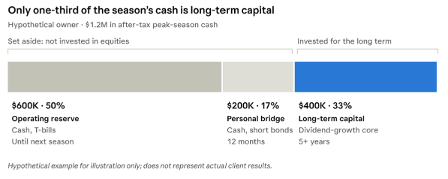
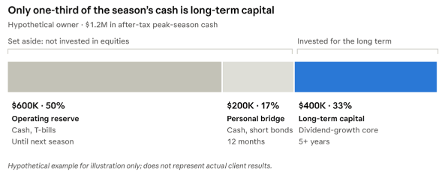
Consider Angela, the hypothetical owner of a holiday décor retailer who finishes the season with $1.2 million in after-tax cash. Her business will need $600,000 for inventory and payroll before next November, and her household needs about $200,000 to cover a year of spending. That leaves Angela $400,000 of long-term capital—one third of the seasonal profits, not all of it.
Repeated across several seasons, this third capital pool may grow into a second income stream, paid by many companies on a calendar that has nothing to do with Black Friday.
Why Dividend Growth Fits in the Long-Term Pool
Income that arrives on a different calendar. Because companies pay on different schedules, dividends from a diversified portfolio may arrive throughout the year, a useful complement to income concentrated in a single quarter.
Diversifying beyond the business. Income from companies across a range of sectors can help diversify the economic drivers behind an owner’s income, not just the asset class. For a retailer, that may mean deliberately limiting consumer discretionary exposure, which could compound risk already carried.
A familiar experience. Owners accustomed to taking distributions from their business may find dividends easier to understand than a plan built on periodic portfolio withdrawals.
Dividends are not guaranteed, and dividend-focused strategies can lag broader markets during speculative phases. They complement diversification rather than replace it.
Revisiting Goals Heading into 2027
Year-end, just after peak season, is a natural checkpoint. Three conversations are worth having:
-
Tax coordination. Work with the client’s CPA on the timing of profit recognition and retirement plan contributions, which can be significant after a strong season.
-
Exit and succession. The Exit Planning Institute’s 2023 National State of Owner Readiness Report found 75% of surveyed business owners want to exit within the next 10 years. Seasonal owners’ timelines deserve attention too, especially if the business depends heavily on them at peak.
-
The portfolio as rehearsal. A long-term pool built now can become the foundation of the portfolio that may one day replace the business, giving the client years of experience living with, and trusting, investment income.
The Bottom Line
For seasonal business owners, the goal isn’t to maximize the windfall; it’s to ensure their financial life doesn’t hinge on a single season. That means separating what the business requires from what the household needs, and investing only what is left over. Done in that order, peak-season profits can become income that works all year.
