

Jennifer Smith (I’m calling her that because she did not want her real name used in my column) has been with an RIA in a small town outside of Baltimore for three years now.
This is her first Schwab Impact, and Schwab is her RIA’s primary custodian with more than $700 million in assets. Fidelity is a secondary custodian, thanks to a couple of other advisors who had merged their firm with hers; she is a partner but not its principal. He is 65, she said, and has yet to decide upon a succession plan, a problem she and the other partners are wrestling with how to address and one of several areas she has sought input on with fellow advisors.
What has confronted her here at Impact, however, is a conference in full artificial intelligence hyperdrive. On the second full day of the conference, many of the AI sessions were already listed as full based on the number of attendees who had added them to their own agendas via the Schwab mobile conference app.
Anthropic has announced 11 integration partnerships at the conference. (I wrote about Jump, the first to lift its publishing embargo.)
Each of the two times I witnessed Jillian Altamura, Anthropic’s head of wealth management go-to-market strategy, she spoke about them at the AI Lounge—a large, open booth area in a high-traffic, fairly central location—with her headset on and her voice broadcast through speakers. Both times, she was encircled by hundreds of densely packed conference attendees on three sides, giving her their full attention.
It has, by far, been the most crowded area of the exhibit hall each time.
As for Smith, the advisor, she is a bit of a hero in that she had been a financial advisor earlier in her career but took time off to have a family and get her two kids well on their way to becoming fully formed young adult human beings before returning to the work world 15 years later.
“It is pretty intimidating, I’ve missed a lot,” Smith said.
When it comes to AI, she said she is excited about the potential she keeps hearing about, and, in fact, another partner at the firm who is leading efforts around AI adoption has signed the firm up to use Altruist’s Hazel.
“If it can do everything they say it can, it will be a very big help in taking meeting-related work off our plate, or at least making it all more efficient,” she said.
She said she was glad not to be at the conference and to have to make the decision about what the firm should adopt herself.
Stop Talking About AI
I asked Humanity Labs founder and CEO Andrei Pop about the hype.
“We should stop talking about AI,” he said, noting that we should really begin to think of AI not in a “Gee whiz” way but more like we think of electricity or other utilities.
“The way most people experience our autonomous workforce is that the work just gets done. It is an incredibly powerful set of technologies that allow that to happen,” said Pop, who added that he did not want to discount the achievements made in its development. “We are in the part of the cycle where we are talking about utilization, not outcomes, and the why and how of it can get lost a little bit. We need to focus more time talking about what is possible.”
On that note, he reminded me that he and Marty Bicknell, CEO and president of the $630 billion AUM national RIA, Mariner, would soon be on stage at the conference discussing outcomes.
In July, Mariner entered into a five-year partnership with Humanity Labs to scale an AI workforce representing more than 700 full-time equivalents across its operations.
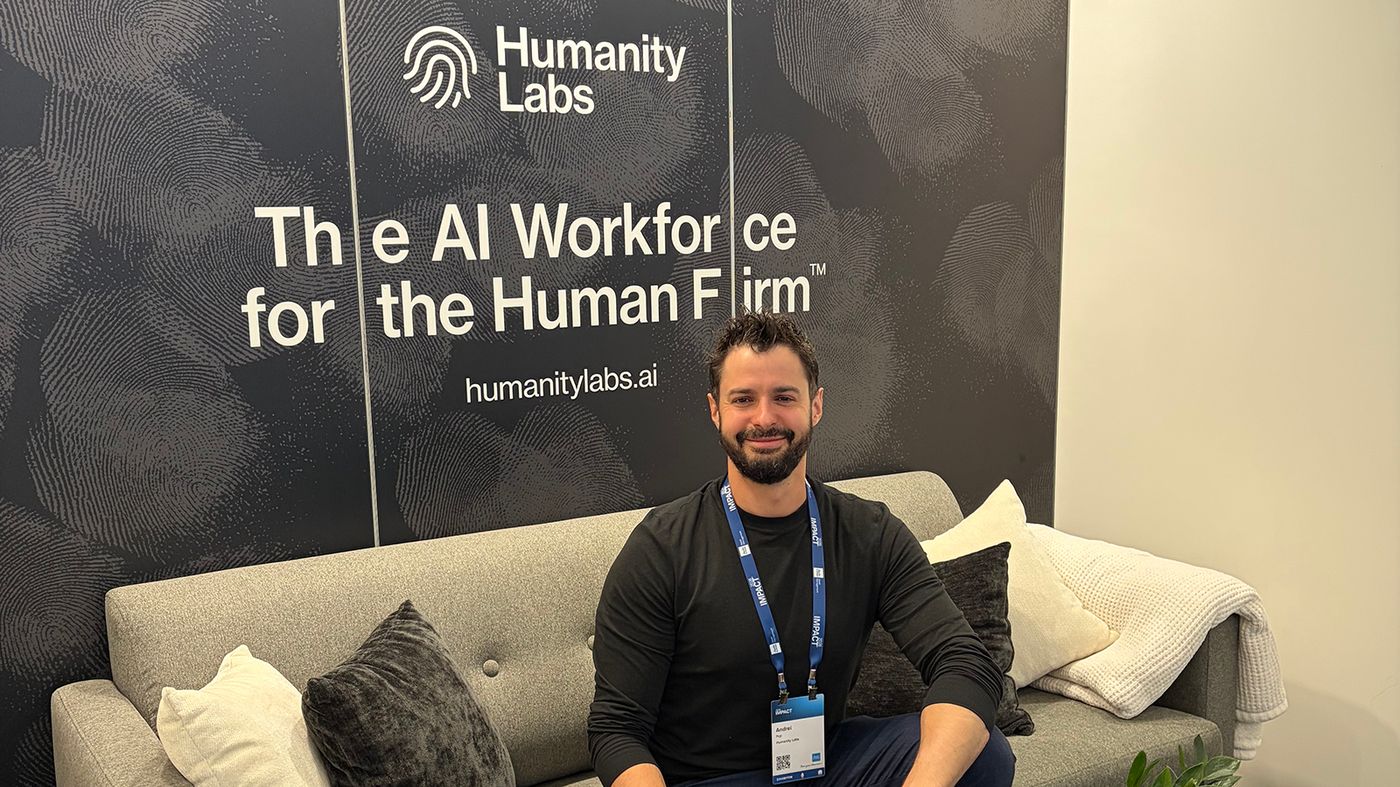
Humanity Labs founder and CEO Andrei Pop a
Pop, put this into simpler to understand terms by saying that a member of its AI workforce costs $50,000 a year, but with that, the firm gets a worker that works the FTE equivalent standard of 2,080 hours a year, but without the need for paid vacation time, health insurance, sick days, etc.
“The future is here, it is just not equally distributed,” Pop said, adding that the advantages will be accrued at first by maverick firms, both large and small, that can think about the outcomes they want to achieve and laser focus on what work can best be done by technology and what’s best left to advisors. (To him, it’s obvious and mainly related to advice and decisions that need the human touch and reassurance.)
It Is About ROI
Another AI founder I had long wanted to meet and finally connected with was Mark Swan, CEO and co-founder of Nevis, which recently raised $70 million in Series B capital, bringing its total funding to $110 million.
I asked about how much of what I was seeing was hype. He responded without hesitation: “I think it is real. What matters at the end of the day is whether you are helping firms grow and grow consistently?”
He then went on to quote several metrics that some of the more than a dozen AI productivity platforms I’ve spoken with over the last two years will not.
“They are saving 10 hours a week, the average advisor is doing 30% more prospect meetings, dozens of firms that have frozen hiring, and multiple firms have replaced Salesforce for CRM with us,” Swan said of the advisory firms that have partnered with Nevis. Those include United Capital, IEQ Capital, GC Wealth, and Focus Financial, among others.
I asked, as I always do, how large his team is and how many engineers there are, and he answered without hesitation.
“It is at about 70 people right now, and about 60 of them are engineers—the capital we raise goes back into the product—we’ve been able to attract some of the best talent, many are former Revolut engineers that had and left, and some even published other work and gone on and have done their own things,” he said.
Nevis, which emerged from stealth mode last year, was founded in 2024 by Mark Swan, Ivan Chalov and Philipp Burda. The three met each other while working at Revolut, the successful British fintech firm and online bank.
“It all comes from talent at the end of the day, and we had an extreme interest and liked being at the forefront,” he said of the work done at Revolut, and that continues at Nevis.
