


On September 8, Canada begins charging its own importers 15%, 25% and 50% on roughly 700 lines of American goods. The measure is billed as dollar for dollar, and on the arithmetic of covered trade it is. What it is not is a tax on the United States. The money is collected at Canadian ports from Canadian importers, and the market that has spent ten weeks repricing this dispute has already worked out who pays.
That market is not the currency. It is the Canadian rate curve, and it has moved in the direction almost nobody covering this trade war has written down.
The agreement survived, the preference did not
Start with the thing being reported backwards. The United States-Mexico-Canada Agreement (USMCA) did not collapse on July 1. Washington declined to confirm a sixteen-year extension at the six-year joint review, which is a different act with different consequences. The agreement remains in force to July 1, 2036, with its preferential rates, its rules of origin, its investment protections and its dispute procedures all operative, and annual reviews now run until the parties extend or the term expires.
What changed is that origin stopped being a defence. The duty that took effect at 12:01 Eastern on August 22 was proclaimed under Section 338 of the Tariff Act of 1930, a provision never used to impose tariffs in its ninety-six years on the books and never construed by any court. It carries no investigation requirement, no defined trigger and no expiry, and its second subsection escalates to excluding a country’s products outright. A Canadian good can certify perfectly under the agreement and pay 50% anyway.
Read that against the grievance. The dairy complaint at the centre of the proclamations has already been litigated twice under the agreement’s own dispute chapter. The 2021 panel found against Canada’s quota allocation, Canada changed its practice, and the 2023 panel largely rejected the renewed American claim. A 1930 statute is now collecting what the treaty’s own machinery declined to award.
The last instrument was refundable, this one is not
The choice of statute is the part worth slowing down for, because Washington has just been through the alternative. On February 20, the Supreme Court held that the International Emergency Economic Powers Act (IEEPA) does not authorise tariffs. Roughly 166 billion Dollars had already been collected under it. About 100 billion has gone back, across more than 25 million entries, against a universe of more than 330,000 importers and more than 53 million entries still in scope.
That is the largest involuntary refund in the history of American customs, and it is still running. Set beside it, Section 338 has no investigation to challenge, no emergency finding to disprove, no time limit to run out and no precedent to be measured against, because no court has ever read it. The replacement was not chosen for its economics. It was chosen for the absence of a handle.
Both sides carved out the leverage
The exclusions look like restraint and are not. Energy, potash, critical minerals and fish sit outside the American measure, along with anything already carrying a Section 232 duty. That last clause does most of the work. Autos, steel, aluminium, lumber and pharmaceuticals escape Section 338 only because another authority already has them. The carve-out is bookkeeping rather than mercy.
Ottawa has done the same thing in reverse. Its list contains no energy countermeasures and no potash, and the finance minister presenting it described the response as proportionate. Both governments have now built retaliation baskets that avoid the flows carrying real leverage. What is left on both lists is consumer goods.
Who actually pays
Canada has run this experiment before and the whole result is on the books. Customs import duties raised 10.24 billion Canadian Dollars in the fiscal year to March 2026, against 6.211 billion the year before. In between sat the broadest counter-tariff regime in modern Canadian history. Monthly receipts ran near 445 million through 2024, stepped to a peak of 1.211 billion in June 2025, and have since fallen back to 727 million, most of the way to where they started, a decline the Department of Finance attributes to the repeal of those countermeasures.
So the widest retaliation Canada has ever run raised roughly 4 billion Canadian Dollars more than the year before it, across twelve months, and then gave most of it back.
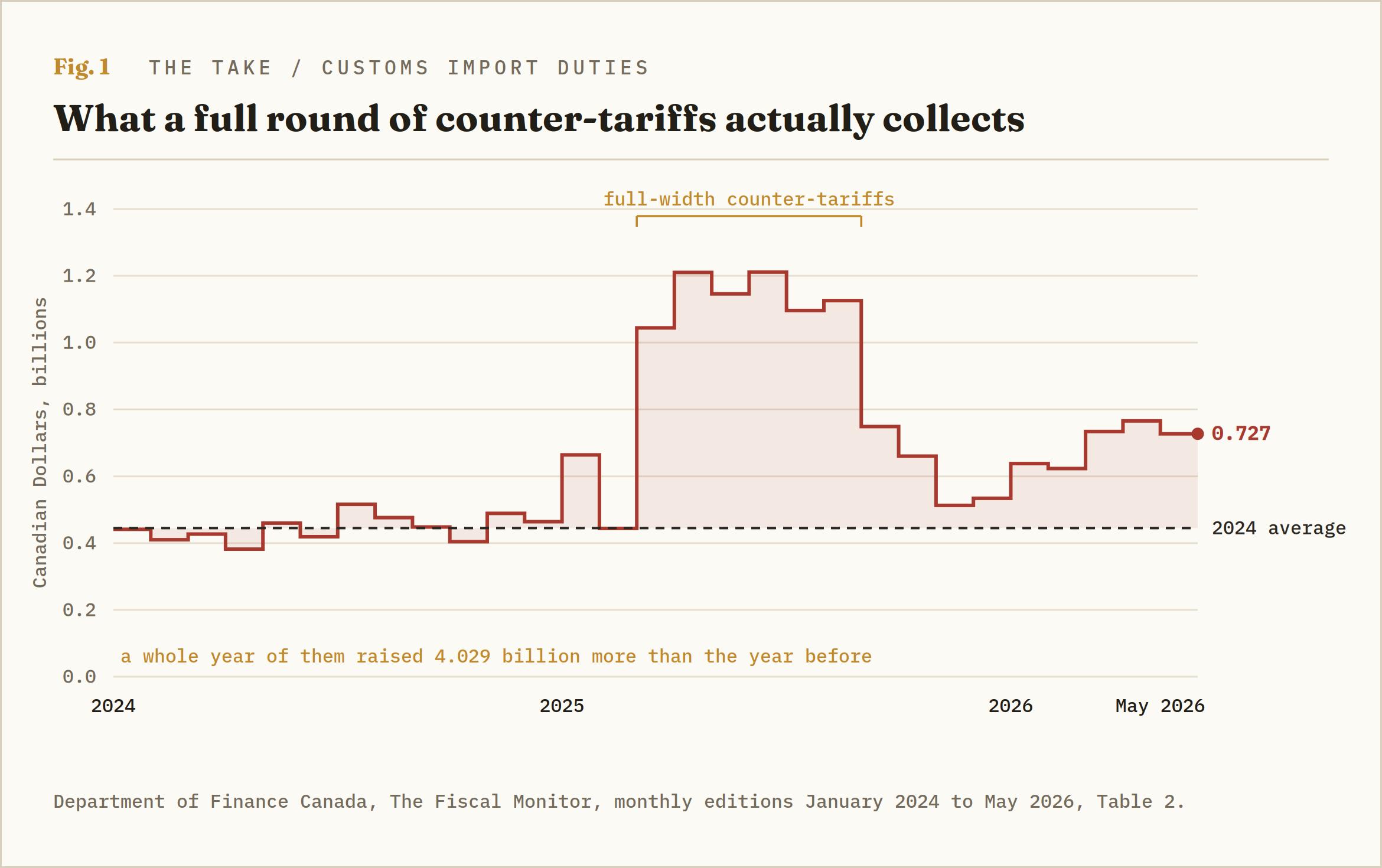
Which tells you what the instrument is for, because it is plainly not for that. Smartphones carry 50%. So do perfumes, cosmetics, tableware, cutlery, doors and windows. Seafood, cheese and large kitchen appliances carry 25%. These are shelf items, and the duty on them is paid in Canadian Dollars by Canadian buyers long before any American exporter notices a change in order flow.
The timing sharpens it. Canadian imports from the United States set a record in June, led by computers and peripherals rising 59% to a record of their own on data-centre processing units bought from American suppliers. Imports from everywhere else fell. Ottawa is drawing a retaliation basket against a bilateral flow at an all-time high, and one of the ministers on the podium holds the artificial intelligence portfolio.
The support is the tell
Tuesday’s package commits 7.5 billion Canadian Dollars on top of nearly 25 billion already provided since the American tariffs began. The largest component is 3.5 billion of worker and employer support, including a waived waiting week, twenty extra weeks for long-tenured workers and, for the first time, access for people who leave a job voluntarily under defined conditions.
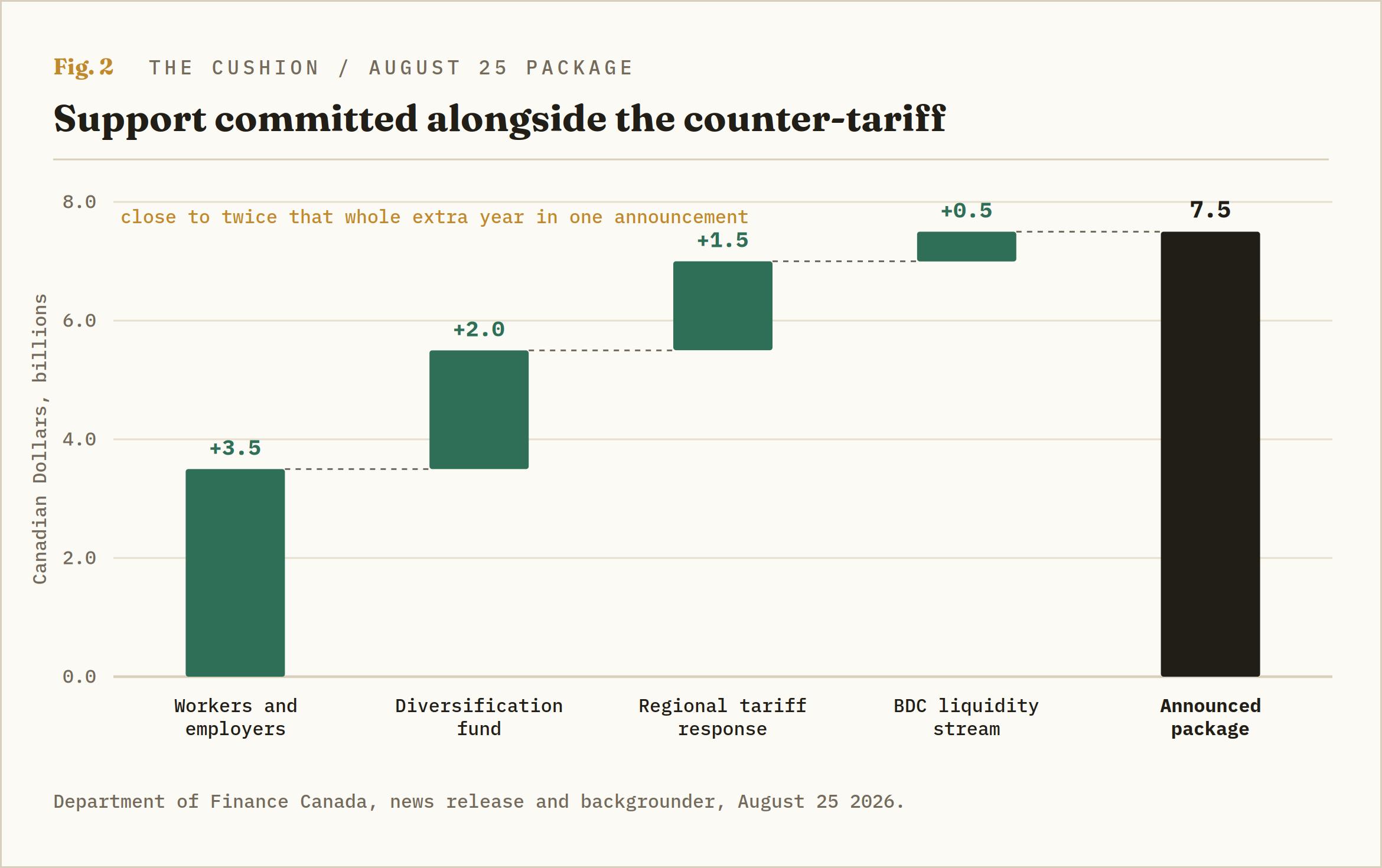
Set that against the 4 billion and the shape of the policy appears. A single announcement commits close to twice everything the last full round of counter-tariffs raised in a year, and the running total of support is roughly eight times it. Officials briefing the measure said the objective is not to raise revenue, which is candid and correct. Asked what it will cost Canadian consumers and businesses, they declined to give a figure.
That missing figure is the one a reader needs, and its absence is not an oversight. A government publishing the domestic cost of its own retaliation would be publishing the case against it.
The posted rate is not the collected rate
There is a second reason the headline schedule overstates what will actually be paid, and it almost never appears in coverage. Canada runs a remission framework, and the gap between the posted rate and the collected rate is administered rather than published. The largest existing carve-out, the motor vehicle remission order running from April 9 2026 to April 8 2027, withholds both the eligible manufacturers and their duty-free quantities from publication on confidentiality grounds. Canadians can read the rate. They cannot read who does not pay it.
The direction of travel is the other way for everyone else. Broad remission on steel categories lapsed on January 31 2026, and on aluminium and on goods for public health, healthcare, public safety and national security on July 1. Relief is narrowing for the many while the largest exemption stays open and unpublished for the few.
The rationale offered for the new list has the same doubled quality. Officials speaking on background said the products were chosen from stakeholder consultation with the primary objective of protecting domestic market share for Canadian companies. The industry minister, on the record, said the list is designed to target particular American states in order to apply political pressure. Those are two different instruments, described the same afternoon. Only one of them is about prices in Canada, and it is the one that was not said on camera.
The curve worked it out first
None of this is speculation, because the Canadian rate market has published its answer. Overnight index swap (OIS) pricing captured at 18:47 GMT on August 25 runs eight Bank of Canada (BoC) meetings out to July 2027 and prices a hike at every one of them. There is not a single cut anywhere on the path.
The implied overnight target rises from 2.25% to 2.87%, which is 62 basis points, or just under two and a half quarter-point increases. September 2 is a non-event at 3.6%. December 9 carries twelve basis points, less than half a move, and the first fully priced quarter point does not arrive until January 27 2027. Across the ten weeks spanning the proclamations and the collapse of talks, the far end of that path has been marked up by roughly eleven basis points while the first hike slid back a meeting.
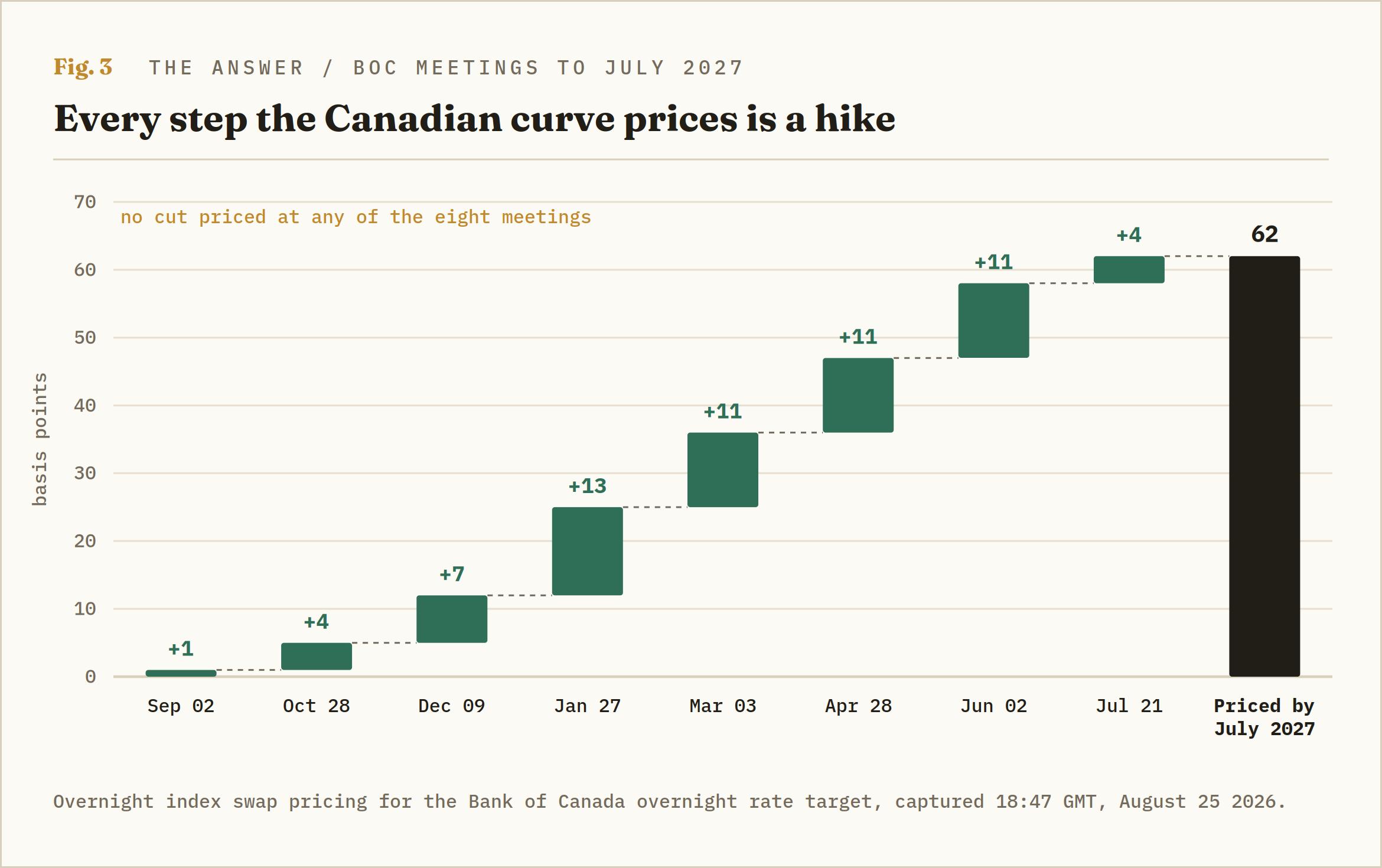
That is a specific shape with a specific meaning. A demand shock drops the whole curve. This one deferred the near-term move and lifted the endpoint, which is what a market does when it expects a price impulse to arrive with a lag and to outlast the growth hit. The counter-tariff is that impulse. Canada is raising the landed cost of 700 categories in the middle of an inflation fight, and the rate market has priced its own central bank to lean against its own government’s trade policy.
January is doing a lot of work
Two things now sit in the same month. The first fully priced BoC increase is dated January 27 2027. The escalation threatened from Washington on Monday, 50% on cars, trucks, automobile parts and steel, is dated January 1 2027.
That second date is where the mutual carve-outs stop protecting anyone. Autos and metals are the flows both capitals have so far routed around, and the threat as posted leaves two questions open that nobody in either government has answered: whether USMCA-compliant vehicles keep their exemption, and whether Canadian steel already paying 50% is being told it will pay 100%. Neither can be traded as fact. Both can be positioned for, because the calendar has put them four weeks ahead of the first move the curve fully believes in.
Where it leaves the Loonie
The currency is not trading a recession either. USD/CAD sits near 1.3850, roughly 3% beneath its year high just above 1.4250, and beneath both its 50-day and 200-day exponential moving averages, with the 200-day near 1.3900 now capping rather than supporting. A 50% tariff landing and a matching retaliation being announced moved the pair by tens of pips, not hundreds.
The lean is lower while the 200-day near 1.3900 caps, with 1.3800 the first objective and the 1.3750 area beneath it. The daily Stochastic RSI reading near 9 says that ground is stretched rather than free, so the near objective carries the call and the far one needs a fresh catalyst. Invalidation is a daily close back above 1.3900, which would put the 50-day near 1.3950 in play and would say the growth read is winning after all.
The event that resolves this is not a tariff. It is the October 28 Monetary Policy Report, the first document in which the BoC has to put a number on what its own government’s counter-tariff does to the price level. The curve has already guessed. If the report validates that guess, the 1.3750 area is a waypoint rather than a floor, and every Canadian importer holding a September 8 order becomes a forced buyer of the answer.
