

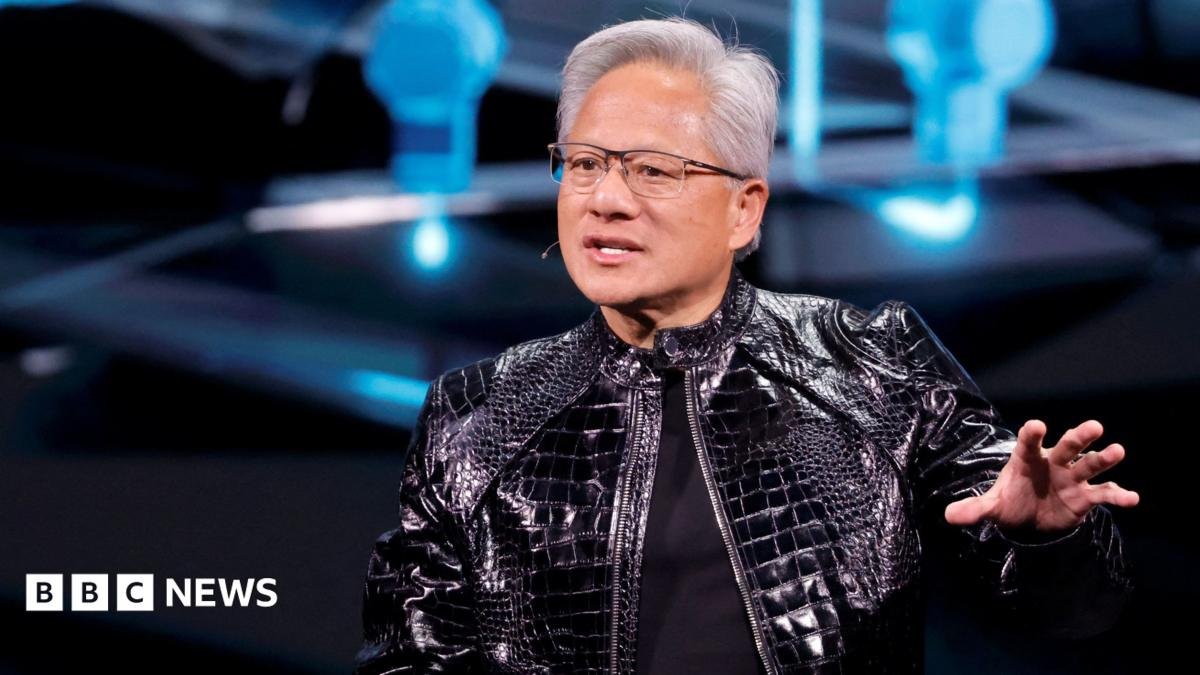
However, his view about “zero-sum game” is not backed by many in national security circles.
Their view is that the race to the most advanced forms of AI is entirely zero sum, and requires the West – and the US in particular – to take critical action to hold back Chinese advancement.
The country that creates the most powerful AI systems, from the most powerful chips, will win, in terms of scientific development, of cracking encryption, economic growth and cyber-weapons.
He made a further argument: Far from being a national security challenge, it was, in fact, better for the US that the world “including China” became dependent on US systems, what they called the “American tech stack”, with Nvidia chips at its core.
Huang then went even further than that, saying that President Trump “is very clear-eyed” about the idea that “this computing technology is not a national security concern”.
He told me “any military is smart enough to build their military on top of their own indigenous technology, and not rely on an adversary to build their technology, build their military capability”.
What does this show us?
At that time, which is the same moment now being independently investigated over national security concerns and alleged Chinese espionage, Huang was making clear public arguments to lift export bans, and seemed to have a clear idea of President Trump’s views.
More than that, he was also disputing the idea that his technology, in China’s hands, was any type of national security concern.
Nvidia is the absolute epicentre of the AI tech boom in the US and of the global race for AI supremacy.
Even if the boom turned to bust, Nvidia is still expected to remain in rude health.
It has actual hard revenues of about $400bn this year. Monday’s drop of about 4% of its value reflects new and extraordinary risks at this junction of tech and global politics, but the chipmaker is still worth more than $4 trillion.
