

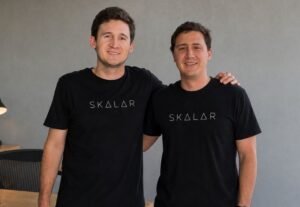
Technology companies routinely spend heavily to acquire customers who may not generate enough revenue to cover those costs for months or even years. A new fintech company, Skalar, wants to finance that gap without taking equity or requiring startups to repay the money on a fixed schedule.
The New York-based company publicly launched Thursday with an undisclosed seed round led by São Paulo-based venture firm Monashees and a debt financing partnership with General Catalyst’s Customer Value Fund. Since its January inception, Skalar has committed to finance more than $125 million in sales and marketing spending across seven technology companies over the next 12 months.
Financing tied to customer revenue

Skalar’s model is fairly straightforward, though somewhat unusual. The company provides startups with capital to fund sales and marketing initiatives. The startups then pay it back out of the revenue generated by the customers acquired with that capital.
If those customers generate less revenue than expected, Skalar says it absorbs the shortfall rather than requiring the company to repay the full original amount.
Skalar’s current deals generally call for it to collect about 1.1x the amount provided.
For example, if a company spends $10 to acquire a customer and expects that customer to pay $1 per month for 30 months, Skalar provides the initial $10 and collects the first $11 that customer generates. Once Skalar reaches that repayment limit, the company can keep the remaining revenue.
But if the customer cancels after eight months, Skalar collects only $8 and writes off the balance, according to co-founder and CEO Sebastián Cárdenas.
“We only get repaid as they get repaid,” Cárdenas told Crunchbase News.
Notably, the startup doesn’t have to pay the capital back by a certain date. Instead, repayment is tied to revenue from the customers acquired with the financing, rather than a fixed schedule. For example, a company that recoups its acquisition costs in one month repays the loan in one month, while one that takes 12 months repays it over one year. So while the obligation remains contractual, Skalar operates under the premise that a flexible timeline reduces the risk of a cash crunch.
How it differs from other financing
Skalar’s structure differs from both venture debt and existing forms of revenue-based financing, according to Cárdenas.
Venture debt offers startups flexible funding without equity dilution, but with higher interest and risk. Skalar’s founders contend that paying back that debt can force startups to cut sales and marketing spending or hold onto cash when new growth opportunities emerge.
The model also differs from revenue-based financing, which typically advances money to companies based on signed contracts or revenue they are already generating, the founders said. Instead, Skalar finances a potential new revenue source before it exists and accepts some of the risk that it may never fully materialize.
Taking on that risk means that Skalar has to closely examine a company’s operations. It analyzes detailed transaction data to determine how much the company spends to acquire customers, how long those customers stay, and how much revenue they generate over time. It also means the company is very selective about who it chooses to finance. Skalar’s system continually updates company assessments as new information comes in, according to co-founder and COO Daniel Castrillón.
“We have become experts in understanding these types of risks and when they are sufficiently predictable and sufficiently profitable to be underwritable,” he said.
The risks for founders
The arrangement is not without risk for startups, concedes Cárdenas. Skalar sets minimum revenue targets for the companies it finances. If results fall below those targets, it can require faster repayment. It can also stop providing additional capital under certain circumstances, which could leave a company without funding it had expected to receive.
Its terms are based on estimates involving customer revenue, profit margins, currency fluctuations and which sales can be attributed to a particular marketing investment. If those estimates prove wrong, or if the cost of acquiring customers rises, the startup may receive less benefit from the arrangement than expected, Cárdenas said.
Importantly, Skalar’s agreements do not give it the right to seize a company’s assets in the event of a default, Cárdenas said, and they do not require borrowers to maintain specific financial benchmarks or cash balances.
Still, founders must weigh the possibility of accelerated repayment or interrupted funding when deciding whether the financing fits their plans.
“Our structure is fundamentally different because it absorbs most of the downside risk … and we are unlikely to walk away unscathed if something bad happens. This incentivizes us to always be mindful of not encumbering the companies we work with with credit risk, as this ultimately increases risk for us,” Cárdenas told Crunchbase News.
A narrow initial customer base
Skalar is targeting technology companies that spend between $100,000 and $3 million per month acquiring customers and have a consistent record of earning more from those customers than they spend to acquire them. It also considers whether a company has enough cash to remain in business long enough for that customer revenue to arrive.
Its first seven customers include four or five Latin American companies, Cárdenas said, as well as businesses in the United States. Skalar initially plans to work with no more than 15 companies per year.
The company declined to disclose the size of its seed round, which closed during the first quarter. Cárdenas described it as a large seed round by Latin America’s standards. Nido Ventures and several angel investors with relevant industry experience also participated.
General Catalyst is providing the debt capital Skalar will use to finance its customers’ sales and marketing spending. The size of that partnership was also not disclosed.
The General Catalyst connection
Skalar grew out of Cárdenas’ work as an entrepreneur-in-residence at Monashees, where he helped introduce several of the firm’s portfolio companies to General Catalyst’s Customer Value Fund model.
General Catalyst pioneered a similar approach but increasingly focused on larger financing deals, Cárdenas said. That created an opportunity to serve smaller companies, including startups in Latin America.
“The best companies are thoughtful about matching their sources and uses of capital: equity for transformative but unstructured product and R&D bets, low-cost, duration-matched capital for predictable investments like customer acquisition,” Andrew Ziperski, partner at the Customer Value Fund, said in a statement. “Most technology companies in Latin America have never had the choice, and Sebastián came to us with that gap in mind. As an investor in the region, he saw the CVF model transform a handful of companies in his own portfolio, and he pitched us on closing the capital gap together.”
Still, Skalar is not restricted to financing businesses with no connection to either General Catalyst or Monashees. Monashees general partner Caio Bolognesi said his firm does not have access to the confidential operating data that startups provide to Skalar as it evaluates their businesses.
For Monashees, the model addresses the long-standing shortage of growth financing in Latin America. Bolognesi told Crunchbase News that his firm, the largest venture firm in Brazil, has watched companies with strong customer performance struggle to secure enough money to pursue their growth opportunities, particularly as equity investment in the region rose and fell.
“We’ve seen capital flow into and out of the growth stage, leaving some excellent companies struggling to raise the equity they need to keep growing,” he said. “Skalar fills that gap by giving promising companies access to capital while they build the track record investors want to see.”
A market beyond venture-backed startups
Skalar is initially focused strictly on financing customer acquisition. Its founders eventually envision offering similar products for other business expenses that produce sufficiently predictable returns.
Cárdenas also sees a longer-term opportunity beyond the relatively small group of companies able to attract institutional venture capital. Businesses that have trouble raising venture capital because of their location, industry or growth rate may still qualify for Skalar financing based on their financial performance.
“Venture capital solved the problem of funding the top 1% of tech businesses,” he said. “But 99% of tech businesses — out of which I’d say probably more than half could be underwritten by our product — just don’t have access to capital today, and ours is a product that fundamentally changes that.”
In the long run, Skalar is betting that its approach can bring growth financing to a much larger group of companies. For startups that can raise venture capital, it also offers a way to fund predictable growth without giving up more ownership.
Related reading:
Illustration: Dom Guzman

Stay up to date with recent funding rounds, acquisitions, and more with the
Crunchbase Daily.
