

Imagine joining a startup as employee number 10. Your salary is a bit below what the market pays for your role, but, in exchange, you get equity. How much? 0.25% of the company to be exact.
You do the math in your head—if the company sells for $100M in a few years, you’ll make $250,000. Not bad, right?
Wrong, and for quite a few reasons. Once you take into account how startup equity typically works, that initial equity grant is worth $97,500, not $250,000.
Let’s walk through why this is the case and then answer an even bigger question: is startup equity a bad deal?
Why Initial Equity Isn’t Exit Equity
Startup equity is confusing because most of what determines its value happens behind the scenes (outside of an employee’s control). This is why, as an employee, your equity at exit is rarely what your initial grant was. This happens for the following reasons:
- Vesting: Most startup equity vests over four years with a one-year cliff. This means you get nothing if you leave within the first year. But if you make it past year 1, 25% vests immediately and then the remaining 75% vests monthly at 1/48th of the total grant (~2.08% per month). So, if an employee with 0.25% of the company leaves after 2 years, they are only entitled to 0.125% (or half) of their original equity.
- Dilution: Dilution is a common practice where subsequent financing rounds reduce the total amount of equity owned by everyone in the company. Typical dilution rates are 20% for Series A, 15% for Series B, and around 10% in each round thereafter. So your 0.25% could be 0.15% after a Series A, Series B, and Series C [0.25% * 0.8 * 0.85 * 0.9 = 0.15%]. There are also pool refreshes where new shares are created for future employees, which can further dilute your shares. These can be offset by refresher grants that you receive for staying longer, but this isn’t always the case.
- Liquidation Preference: Even when a company is sold or acquired, if the amount it exits for is below a certain exit price, then liquidation preferences take hold. For example, imagine a startup raises $10M for 50% of its equity, valuing the company at $20M with a 1x liquidation preference. The liquidation preference means that the venture capitalists (VCs) who gave the company the $10M, get the higher of 50% of the sale price or their $10M upon exit. So, if the company is sold for $15M, the VCs would get their $10M back since 50% of the sale price is less than $10M. This means that the remaining $5M is left for the founder(s) and employees.
Liquidation preferences prevent a founder from raising money and then immediately selling the company and pocketing the proceeds. So, even if you own 0.25% of the company, after liquidation preferences, your 0.25% would apply to a smaller pool of funds.
- Post-Termination Exercise Period (PTEP): Arguably the biggest issue that prevents employees from realizing their equity isn’t related to financing mechanics, but timing. While equity tends to vest over four years, many startups take much longer to exit. For example, PitchBook found that the median time to IPO for tech companies was 11.5 years. Jared Heyman did an analysis on YC companies and found that bigger companies (>$1B) took about 9 years to exit while smaller ones (<$100M) only took 3 years.
The issue is that if you leave your startup early, you typically have 90 days to decide whether to exercise your stock options. This is called the post-termination exercise period and it is the biggest risk a startup employee takes once they are no longer with the company. You can exercise these options and pay the tax due, yet you’d still need to wait for a payoff…if it ever comes.
- Exercise Cost: Even if you do decide to exercise your options, doing so isn’t cheap. Since your strike price is set by the company’s valuation when you’re hired, later employees face far higher costs than early ones. Their exercise cost can often be five figures or more, all due within 90 days of leaving. That’s cash locked away for years, earning nothing, with no guarantee of getting it back. Employees who don’t have this spare cash walk away empty-handed. Thankfully, some companies now offer a 5-year to 10-year PTEP window, which reduces the stress over whether to exercise your options immediately upon leaving a startup.
- Taxes: When it comes to taxes, your startup equity typically gets taxed twice. The first taxation occurs when you exercise your options where the difference between the strike price and the company’s share price gets treated as income (ordinary income for NSOs, or as an AMT adjustment for ISOs). You have to pay this tax in cash immediately though you can’t sell the shares yet (and may never be able to). The second tax comes as a capital gain on any further appreciation of the shares in the event of an exit (IPO, acquisition). These costs aren’t trivial either. Secfi estimated that taxes made up 73% of the total stock option exercise cost among their clients. Imagine paying out cash to buy these options only for the startup to ultimately fail.
Startup equity can be far more complex than this. I’ve deliberately left out RSUs (which later stage companies use instead of options), harsher liquidation preferences, acqui-hires where the common stock gets wiped out, and secondary sales that can provide employees some liquidity before an exit. Nevertheless, you can see how your equity at exit is likely to be meaningfully less than what was originally granted.
Using our opening example, a 0.25% grant could end up diluting down to only 0.17% after two financing rounds [0.25% * 0.8 * 0.85], meaning $170,000 gross on a $100M sale. Net out the cost of your options (assume $7,500 flat) and taxes (40%) and you are left with $97,500 [($170,000 – $7,500) * 0.6]. That’s still a good payout, but 61% less than what you initially imagined.
Now that we know how employee equity grants can be affected before an exit, let’s take a look at how often startups exit in the first place.
How Often Do Startups Exit?
When it comes to startup exits, the vast majority never IPO or get acquired. CB Insights found that only 30% of the 1,119 U.S. seed companies they tracked had an exit. The rest either failed, stagnated, or became profitable enough to not require future financing rounds. Either way, the equity outcome for the employees was the same—no liquidity event or payout.
This is where startup equity and the equity in a typical business differ. In a typical business, equity can pay out distributions over time. But with startups, equity payouts rarely come outside of an exit.
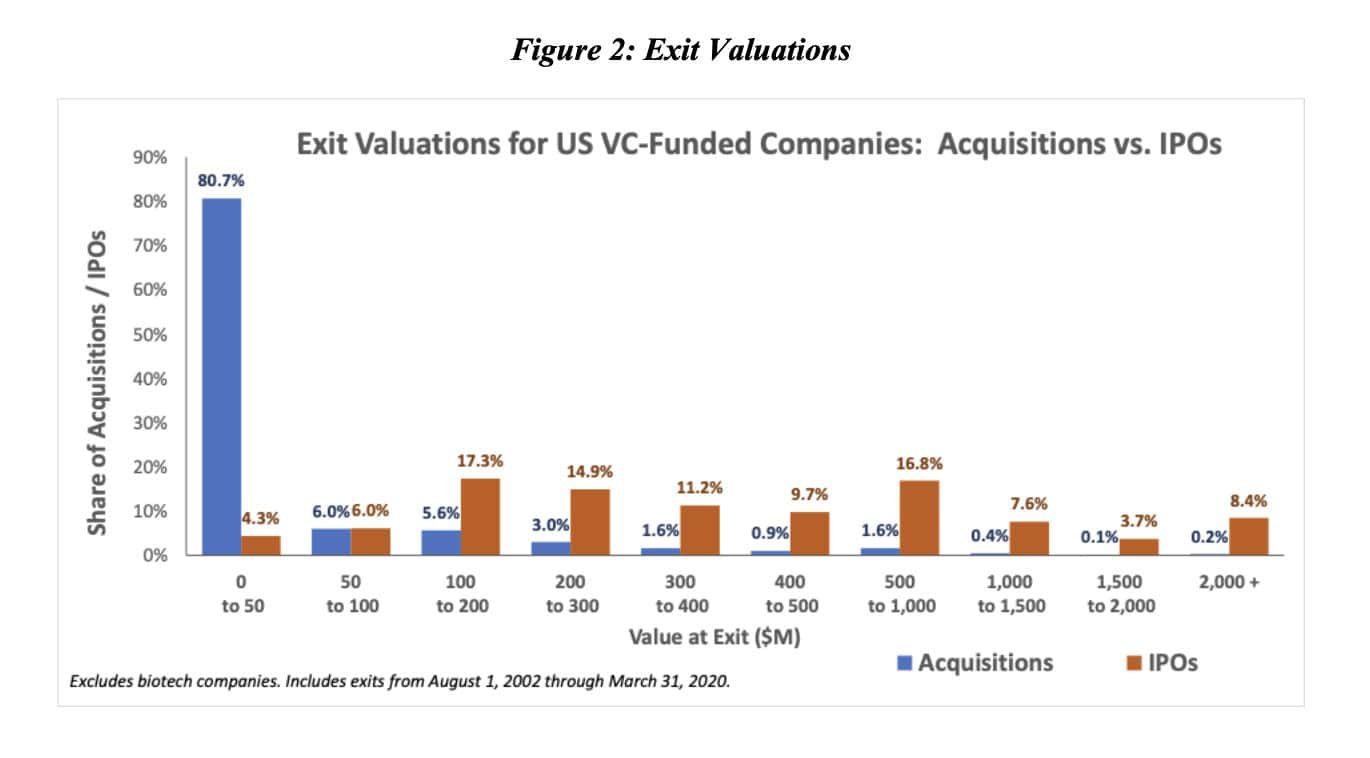
And not all exits are created equal either. A working paper from Adigital found that more than 80% of U.S. tech startups between 2002 and 2020 were acquired for under $50M. You can see this more clearly in this chart which shows the distribution of exit valuations of U.S. VC-funded companies (acquisitions vs. IPOs):

While this data suggests that large IPOs are more common than large acquisitions, you have to keep in mind that there tend to be 30x more acquisitions than IPOs. In 2016, CB Insights reported that there were 3,260 M&A exits globally, but only 98 IPOs (33x more). And the lack of IPOs since 2022 has only widened that gap.
From the data shown thus far, I’ve estimated that:
- 70% of startups don’t exit
- 25% exit for under $100M
- 4% exit for $100M-$1B
- 1% exit for over $1B
Given this, let’s walk through how much an early startup employee would make depending on the size of their company’s exit.
How Much Do Early Startup Employees Make Upon Exit?
The amount of money a startup employee makes upon exit will be determined by how much equity they have, the deal terms, and the size of the exit. Rather than varying all of these at once, let’s look at an employee with a fully vested 0.25% initial equity grant (our hypothetical employee #10 at a startup) and how much they would make across various exit sizes. We will assume a flat 40% tax rate, a fixed $7,500 cost to exercise all shares, and share dilution of 20% in Series A, 15% in Series B, and 10% in each round thereafter.
If we were to do this for various exit sizes, here’s how much our hypothetical startup employee would make in each scenario. Note that I’ve used $50M, $300M, and $1.5B as representative values within each exit tier.
- No Exit (70% of Startups) = $0
- This assumes a startup that sees no liquidity event.
- Small Exit (25% of Startups) = $55,500
- This assumes a startup that exits for around $50M after one funding round which dilutes the equity down to 0.2% [0.25% * 0.8]. This leads to $100,000 in gross proceeds. Net out the $7,500 exercise cost and the 40% tax on the gain and you are left with $55,500.
- Big Exit (4% of Startups) = $270,900
- This assumes a startup that exits for around $300M after three funding rounds which dilute the equity down to 0.153% [0.25% * 0.8 * 0.85 * 0.9]. This leads to $459,000 in gross proceeds. Net out the $7,500 exercise cost and the 40% tax on the gain and you are left with $270,900.
- Unicorn (1% of Startups) = $1,110,870
- This assumes a startup that exits for $1.5B after five funding rounds which dilute the equity down to 0.124% [0.25% * 0.8 * 0.85 * 0.9 * 0.9 * 0.9]. This leads to $1,858,950 in gross proceeds. Net out the $7,500 exercise cost and the 40% tax on the gain and you are left with $1,110,870.
If we do an expected value calculation across all of these outcomes, our hypothetical startup employee would have an expected payout of $35,820. That’s not nothing. But when you consider the risk, the four years it takes to vest, and the below market salary, it’s much lower than many would hope for.
For example, if you were paid $20,000 per year less than your market value to join a startup, that’s $80,000 of forgone income (or $48,000 after 40% taxes). Your $35,820 expected payout (which arrives years in the future) wouldn’t make up for it.
Of course, the devil is in the details. If you used a 0.5% initial equity grant, all the numbers here would be roughly doubled. If you included liquidation preferences or the present value of these payouts, the expected value would be much lower. More importantly, if you left before an exit and couldn’t afford to exercise your options within 90 days, your payout would be zero.
Either way, in our base case, there’s roughly a 5% chance of a six figure (or higher) payout for an early startup employee. Is this worth it to you? I’m not so sure.
So far we’ve looked at an early startup employee’s equity experience. But what about the typical startup employee who isn’t employee #10 (or earlier)? Are they any better off? Let’s take a look.
What About the Median Startup Employee Payout?
In the example above we analyzed how an early startup employee (#10) would fare under different exit scenarios. We assumed that there was a 70% chance that the employee would never realize any of their equity. However, this doesn’t imply that 70% of all startup employees never realize their equity.
Why? Because of company size. Larger startups employ more people than smaller ones. And since larger startups are more likely to exit than smaller ones, this means that the typical (or median) startup employee is more likely to see an exit as well.
For example, let’s make the following assumptions about company size based on exit size (which I’ve estimated from Carta’s data here). Note that Carta estimates employee size at funding (not exit), so I’ve adjusted upward where applicable:
- No Exit = 20 employees (on average)
- Small Exit = 70 employees (on average)
- Big Exit = 250 employees (on average)
- Unicorn = 1,000 employees (on average)
If we assume that this is roughly accurate, then, for every 100 startups, we would expect a total of around 5,150 total employees (broken down as follows):
- 70 No Exits * 20 employees = 1,400 total employees (27% of total)
- 25 Small Exits * 70 employees = 1,750 total employees (34% of total)
- 4 Big Exits * 250 employees = 1,000 total employees (19.5% of total)
- 1 Unicorn * 1,000 employees = 1,000 total employees (19.5% of total)
Once we control for company size, roughly 73% of startup employees experience an exit even though 70% of startups don’t.
If we ordered all of these employees, the median (50th percentile) employee would be in the “Small Exit” bucket. We can assume that they would be the median employee at one of these companies too, which makes them employee #35 (out of a 70 person company). Since they joined later than employee #10, they probably only got a 0.05% initial equity grant (in my estimation). And if we assume a $50M exit after one dilution round, that equates to only $20,000 [0.05% * 0.8 * $50M] in gross proceeds from their shares.
After deducting the exercise cost ($1,500) and taxes (40%), the median startup employee in this scenario would receive an $11,100 payout. And this assumes that the employee fully vested and that they exercised all of their options.
Unfortunately, this last assumption has become increasingly unlikely. As of late 2024, Carta found that startup employees exercised just 32% of their options that were fully vested and in the money (i.e., the current value of the options was higher than the strike price). As the startup ecosystem has gotten more challenging in recent years, fewer employees are willing to lock up their cash for years with no guarantee of a payoff. As Heather Doshay, a partner at SignalFire, stated:
It’s not necessarily a three-year or four-year investment anymore. It could end up being a decade-plus investment. You just don’t know.
Though equity compensation for the median startup employee doesn’t seem like a great deal, there are some ways to make it better.
How to Make Startup Equity into a Better Deal
While the economics of startup equity aren’t particularly attractive for the typical startup employee under the typical exit scenario, there’s a long right tail that can make it worth it. While this sort of outcome is unlikely (a 5% chance of a six figure payout), no such upside exists for nearly all 9-to-5 jobs.
With that being said, the real case for working at a startup isn’t always the equity, but the experience and the network that comes along with it. For someone who is young with low expenses, taking a few swings at the startup world can be incredibly rewarding without a major hit to your career if they don’t work out.
Still, startups are risky because your paycheck and your equity come from the same place. I’d never recommend that someone take on a concentrated, illiquid asset that is correlated with their main source of income, but then again, that’s why these outsized rewards exist in the first place.
Given this, there are a few ways you can make your startup equity into a better deal for yourself:
- Pick trustworthy founders (and coworkers)
- The most important decisions about your future equity will be made by the people leading your startup. Selecting trustworthy founders is how you protect yourself from being screwed over in the future. While filtering for trustworthiness is more of an art than a science, if you don’t trust the people in charge, don’t sign up.
- Negotiate your exercise window
- Some companies offer 5-10 year post termination exercise periods (PTEP) rather than the standard 90-day windows. Getting your PTEP window extended is the single most valuable thing you can do to lower your future anxiety and give yourself optionality when it comes to your stock options. If the company won’t budge on this, that tells you something.
- Understand the cap table
- Ask leadership about prior financing rounds, total capital raised, and what liquidation preferences exist. Before you sign up, you need to know who gets paid what if the company sells at various prices. This will help you determine how much your equity would be worth based on different future exit scenarios.
- Understand Qualified Small Business Stock
- While I assumed a 40% tax rate throughout this blog post, the Qualified Small Business Stock (QSBS) provision can dramatically reduce how much you owe on your equity, if you exercise early enough and hold for the required period. While other conditions must also hold (e.g., the shares must be issued from a domestic C-corporation under a certain asset level), QSBS can eliminate the capital gains portion of your tax bill, though not the tax you owe at exercise. This issue is important enough that I recommend consulting a tax professional to see if it applies to you.
Ultimately, is startup equity a bad deal? Statistically, for most employees, it will turn out worse than they hope. But if you negotiate the right terms and set the proper expectations around exit, it can still be worth the risk.
Thank you for reading!
If you liked this post, consider signing up for my newsletter.
This is post 521. Any code I have related to this post can be found here with the same numbering: https://github.com/nmaggiulli/of-dollars-and-data
