

The first interest rate hike in more than three years has caused advisors to spring into action for their clients. But one area that’s getting very little attention is the impact of higher rates on business valuations. When a required return rises, the present value of a closely held business generally falls, all else being equal.
That inverse relationship can create an important planning window for estate planners and wealth advisors. A lower, supportable fair market value may allow a business owner to transfer a larger ownership interest out of their estate while using less of their lifetime gift and estate tax exemption. It can also help to reduce their gift tax.
Keep in mind that company-specific facts still dictate value, and an interest rate increase does not automatically justify a lower appraisal. Even so, for many companies, a high-rate environment tends to place downward pressure on value, giving attorneys, CPAs and wealth advisors a timely reason to revisit the assumptions underlying their clients’ planned gifts.
Where Interest Rates Enter the Valuation
For federal gift and estate tax purposes, Treasury Regulations Sections 25.2512-1 and 20.2031-1 define fair market value as the price at which property would change hands between a willing buyer and a willing seller, assuming neither one is under any compulsion to buy or sell and that both parties have reasonable knowledge of relevant facts. The value is determined based on the valuation date. For a lifetime transfer, that generally means the date of the gift.
Revenue Ruling 59-60 supplies the enduring framework for valuing closely held stock when reliable market quotations are unavailable. This type of valuation exercise requires consideration of all relevant facts and rejects a universal formula. Among those facts are the company’s earnings capacity, dividend-paying capacity, financial condition, industry outlook, goodwill, and comparable-company evidence.
Under the income approach, expected future cash flows are converted to present value using a discount rate that reflects the return a willing buyer would require for the time value of money and the investment’s risks. For an operating business, that rate is often expressed as the weighted average cost of capital (WACC), which blends the required returns on equity and debt based on the company’s capital structure. As market interest rates rise, the risk-free rate and borrowing costs incorporated into WACC may also increase. All else being equal, a higher WACC reduces the present value of the company’s expected future cash flows and, therefore, its indicated value.
Think of the required return as the gravitational pull on future dollars. The stronger the pull, the less those dollars are worth today. In a simple capitalization model, the expected benefit is the numerator and the cap rate is the denominator. When the numerator is held constant, a larger denominator yields a smaller value.
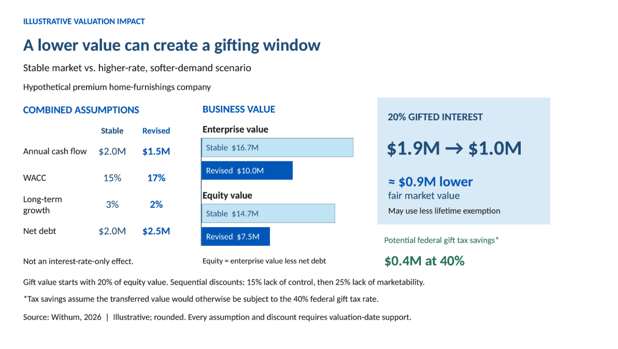
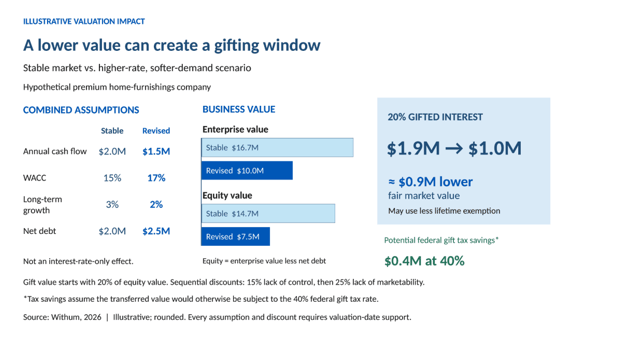
The illustration above reflects the combined effect of lower expected cash flow, a higher required return and increased net debt; it does not suggest that an interest rate change produces a mechanical change in value. The 20% gifted interest is valued from the company’s equity value, after which illustrative discounts for lack of control and lack of marketability are applied sequentially. In an actual appraisal, the operating forecast, WACC, capital structure, nonoperating assets and liabilities, and ownership-level discounts would each require separate support based on conditions existing as of the valuation date, without double counting risks captured elsewhere in the analysis.
Act on the Valuation Date, Not the Headline
The Federal Reserve’s 25-basis-point move is a prompt; it’s not a conclusion. If you have clients with planned gifts of closely held business interests, ask them if the valuation assumptions still reflect current required returns and operating expectations. If they don’t, make sure those clients refresh their financial information and engage a qualified appraiser before completing the transfer.
A higher interest rate does not make every business worth less. It does make the valuation date more consequential. When current market evidence supports a higher required return, a lower defensible value may allow the owner to transfer more of tomorrow’s appreciation with fewer of today’s exemption dollars.
Follow the Rate Through the Model
In a build-up method for estimating the cost of equity, the appraiser may begin with the yield on a Treasury security whose duration is appropriate for the analysis. Then the appraiser will add an equity risk premium, a size premium and a company-specific risk premium. In WACC, the appraiser blends the required returns on equity and debt in proportion to the capital structure. Neither method simply copies the federal funds rate. Instead, each method relies on market evidence that may respond to monetary policy in different ways and at different speeds.
Next, test the internal consistency of the assumptions. A higher risk-free rate may increase the discount rate, but other components may move differently. Credit spreads can widen or narrow. Capital structures vary. Long-term growth should reflect the company’s realistic prospects and the economy in which it operates. Even a modest widening of that spread can have a meaningful effect on value.
Then reconcile the conclusion with the business itself. Revenue, earnings, cash flow and EBITDA form or support the numerator. For some consumer-facing businesses, higher financing costs and selective spending pressure may soften near-term expectations. Those operating effects can reinforce the rate effect, but they require separate support. The appraiser must avoid embedding the same risk in both the forecast and the discount rate.
Still, a 25-basis-point policy move does not require a commensurate 25-basis-point increase in a private company’s discount rate. The connection is directional, not mechanical. A qualified appraiser must examine observable market data, the subject company’s capital structure, expected growth and specific risks. Revenue Ruling 59-60’s instruction to consider all relevant facts remains the guardrail. A headline can start the inquiry. It cannot finish the valuation.
A Simple Illustration
Consider a hypothetical, family-owned company that makes premium home furnishings. Its products are discretionary, so they‘re often sold at high price points and may be financed by consumers. The business may therefore face two related pressures:
-
Higher required returns in the valuation model.
-
Weaker expected cash flow as price-sensitive households postpone purchases or trade down.
The economic backdrop supports testing that downside without assuming it. In July, overall personal consumption expenditures increased, but the Federal Reserve’s August Beige Book also reported heightened price sensitivity and noted that higher-income consumers were increasingly shopping at discount furniture stores.
