


When DeFi dashboard Zapper announced this month that it would shut down after nearly seven years, it joined a growing list of decentralized finance projects that have folded in 2026.
Bitcoin DeFi platform Botanix, Solana portfolio tracker Step Finance, DeFi analytics platform Parsec and DEX aggregator Odos Protocol also wound down or are winding down this year after multiple market cycles.
The carnage isn’t limited to DeFi — RootData has tracked 101 “dead” crypto projects in total this year as of July 26 — but it accounts for more than half the cadavers.
Is it simply a case of bear market blues, or is there more to it than meets the eye?
Botanix’s founders pointed to weak demand when announcing the platform’s closure, and told Cointelegraph in June that onchain activity consolidating around a few venues like Hyperliquid and big centralized exchanges hastened Botanix’s decline.
While complaints the overall industry is consolidating into a fewer, larger venues are common, Artemis Research’s Alex Weseley tells Magazine that’s not the case in DeFi:
“The prevailing narrative has been that concentration is increasing in DeFi, caused by a series of exploits and capital rotation into the most ‘Lindy’ protocols. But the data disagrees.”
So, why are projects that survived the collapse of Terra, the implosion of FTX and the grip of Chokepoint 2.0 shutting down today? If the 2022 bear market didn’t kill these DeFi protocols, what is it about the 2026 market structure that is finishing them off?
Capital has rotated rather than exited
According to Artemis data, concentration across tracked DeFi protocols has actually drifted lower since 2024.
And while each major sector still has one dominant player like Uniswap in decentralized exchanges, Aave in lending and Jupiter in perpetuals by locked capital, “every one of those leaders holds a smaller share of its sector now than it did two years ago,” Weseley explains.
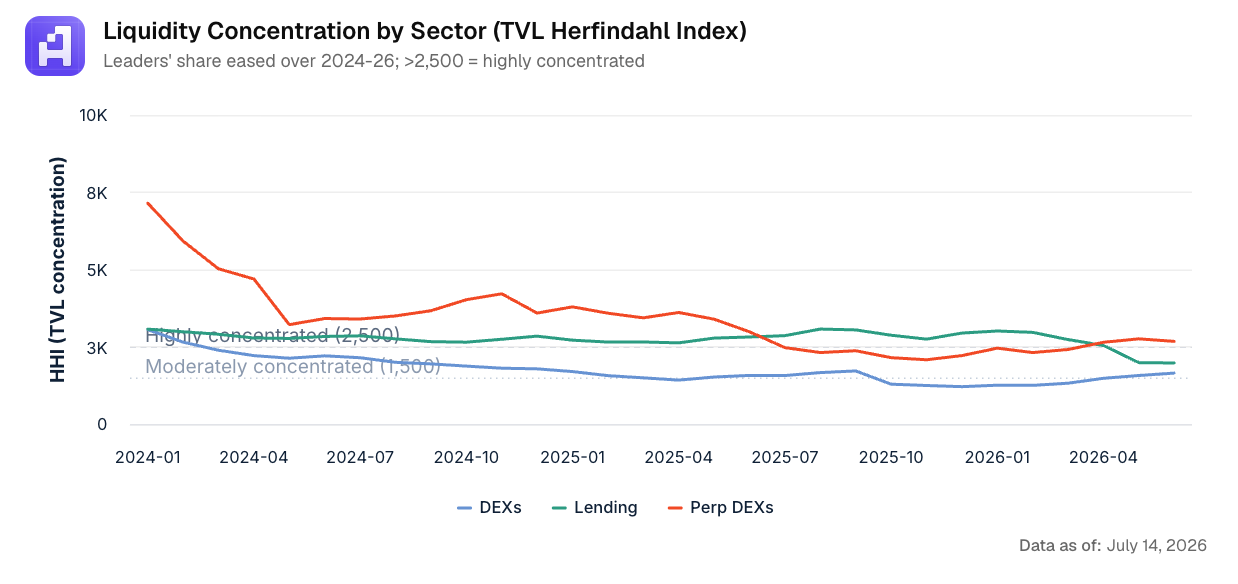
Liquidity concentration by sector (TVL Herfindahl index). Source: Artemis
He argues that onchain activity has shifted into different corners of the crypto economy rather than leaving the ecosystem altogether.
“The economics didn’t disappear; they rotated to adjacent apps (Hyperliquid, Polymarket, pump.fun), so classic DeFi viability shrank even as total onchain fee generation stayed high.”
Related: Mark Cuban-backed DeFi dashboard Zapper shutters after 7 years
In this view more protocols are competing for a slice of the pie, making each slice smaller.
Markus Levin, co-founder of blockchain infrastructure company XYO, says today’s landscape holds little resemblance to the early days of DeFi.
“The DeFi space is much more competitive than it was during the last bear cycle,” Levin tells Magazine.
“Early DeFi projects benefited from first-mover advantage and a relatively small field of competitors. Now, there are thousands of protocols competing for the same users and liquidity.”
Wesley explains it’s more instructive to look at revenue generation to work out where economic activity is occurring in DeFi, rather than the more common measure of total value locked (TVL).
“TVL is the right tool for the narrow ‘liquidity’ question but misleads elsewhere,” Wesley says.
“Fees and revenue are best, because they measure economic viability directly and expose shifts that TVL and headline usage hide.”
Artemis estimates the number of DeFi applications generating at least $1 million in monthly fees climbed to around 33 or 34 in mid-to-late 2025 before falling back to roughly 25 or 26 during the first half of 2026. The number generating more than $10 million in monthly fees roughly halved over the same period.
The rules for attracting capital have changed
DeFi risk management firm Gauntlet argues the broader market remains healthy, despite numerous DeFi protocols shutting down this year.
“Demand is the strongest it has ever been,” Nicholas Cannon, chief business officer at Gauntlet, tells Magazine. “Stablecoin supply keeps growing, and traditional finance is moving toward DeFi rather than away from it.”
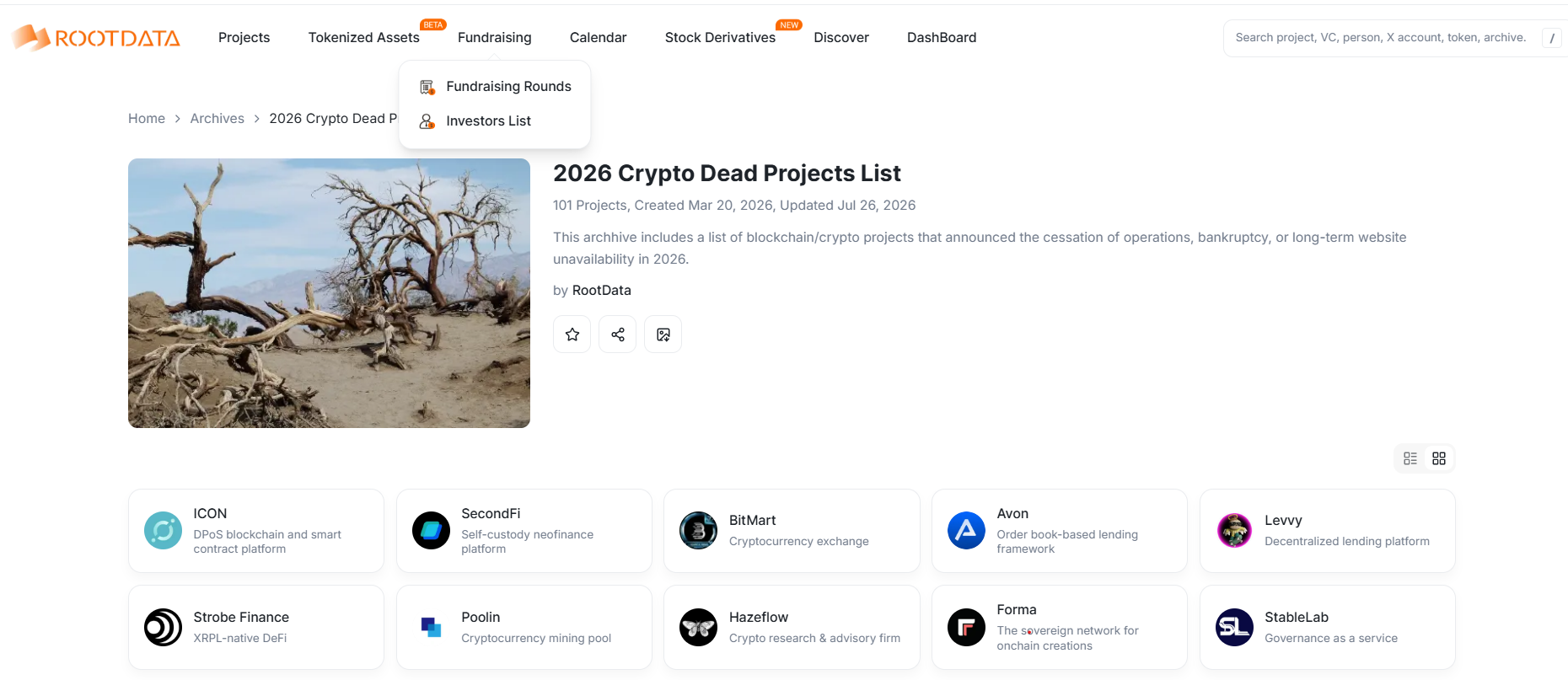
101 crypto projects have died so far in 2026 alone. Source: RootData
According to Gauntlet, the defining change since the previous market slump is that investors have become more selective and aren’t as easily distracted by short-term yield farming token incentives.
“What changed is that capital got discerning. In previous cycles, liquidity followed incentives wherever they pointed. Today it follows sustainable yield, track record, and curation. Incentives still have a role in bootstrapping, but they no longer carry a protocol on their own.”
Levin says that institutional capital in particular is more selective in 2026, favoring platforms with established track records over protocols luring users with shiny token incentives.
“The projects that survive this cycle are likely to be the ones that already have meaningful user distribution or can reach users beyond the traditional DeFi audience,” he said, and that may prove to be a tougher test than the bear market itself.
Tokenized assets, stablecoins and emerging areas such as agentic DeFi are examples of where new experimentation is taking place.
Related: ARK pushes back against a16z’s ‘TradFi wants blockchain, not DeFi’ claim
Infrastructure is consolidating while innovation moves higher
One consequence of the industry’s maturation, Cannon said, is that fewer teams are trying to build the next Aave or Uniswap. Instead, they’re using established DeFi infrastructure as a foundation for their products and services.
The trend is also reflected in where investment dollars are flowing. DeFi lender Morpho announced a $175 million raise to bring institutional lending onchain in June, one of the sector’s largest fundraises, while agentic DeFi startup Alpaca raised $135 million in July to build infrastructure for AI-powered financial applications.
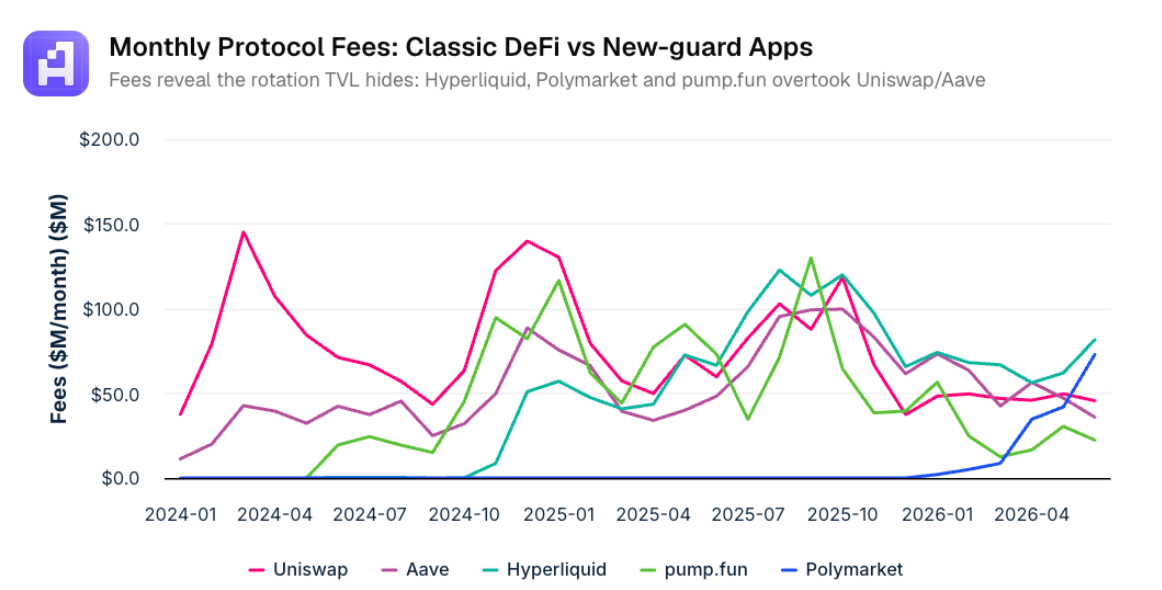
Monthly protocol fees: Classic DeFi vs new-guard apps. Source: Artemis
Morpho Labs co-founder Merlin Egalite says the next generation of successful protocols will increasingly focus on distribution rather than competing directly with established infrastructure.
“The protocols growing fastest will be the ones embedded into the platforms where users already are. Fintechs, wallets, exchanges building on top of you rather than competing with you.”
Egalite also argues that future growth will come from making DeFi infrastructure easier for traditional financial firms to adopt.
“The next wave of growth comes from fintechs, banks, and platforms that want to embed DeFi infrastructure without rebuilding it,” he says.
Magazine: Fears of AI-driven DeFi hack epidemic overstated for now — but not for long
Cointelegraph publishes long-form journalism, analysis and narrative reporting produced by Cointelegraph’s in-house editorial team with subject-matter expertise. All articles are edited and reviewed by Cointelegraph editors in line with our editorial standards. Some articles contain affiliate links, from which Cointelegraph may earn a commission. These relationships do not influence which products we review or our editorial conclusions. Content published in here does not constitute financial, legal or investment advice. Readers should conduct their own research and consult qualified professionals where appropriate. Cointelegraph maintains full editorial independence.
