

A life insurance illustration can detail premiums, death benefits and projected retirement income while leaving a consequential design decision almost unnoticed: whether the policy uses the guideline premium test or cash value accumulation test.
Many universal life policies offer both options, yet few policy owners know the choice exists, much less understand its implications. Even some agents overlook it. However, the selection can materially affect premium capacity, required death benefits, mortality charges and long-term performance.
Neither test is universally superior. The appropriate choice depends on the objectives, funding schedule, death benefit structure and more. As we’ll see, the results can be surprisingly counterintuitive.
Two Tests, Different Rules
Internal Revenue Code Section 7702 establishes two methods for qualifying a contract as life insurance for federal tax purposes.
-
GPT focuses primarily on premium funding. It limits cumulative premiums relative to the death benefit and requires compliance with an age-based cash value corridor.
-
CVAT focuses on accumulated cash value. It requires sufficient death benefit relative to cash value, based on actuarial calculations, without GPT’s separate cumulative premium ceiling.
Put simply:
-
GPT: For this amount of insurance, how much premium can be paid?
-
CVAT: For this amount of cash value, how much insurance must be maintained?
Both tests can require increasing death benefits as cash value grows. However, they can produce substantially different results, even with identical premiums and investment assumptions.
GPT is often attractive for accumulation-oriented indexed universal life (IUL) and variable universal life (VUL), where minimizing unnecessary insurance charges can improve cash value efficiency. CVAT may offer greater premium flexibility, particularly with large initial deposits or future funding changes.
Traditional whole life generally uses CVAT.
The Death Benefit Tradeoff
The relationship between cash value and death benefit is particularly important because mortality charges generally depend on the net amount at risk; the difference between the death benefit and the policy value.
Consider a policy with $1 million of cash value. If one design requires a $1.2 million death benefit and another requires $1.35 million, the latter has approximately $150,000 more insurance at risk.
That additional protection has a cost. If the client needs it, the expense may be justified. If the primary objective is cash accumulation or retirement income, it may be counterproductive.
However, minimizing the initial death benefit doesn’t necessarily minimize long-term charges. A policy beginning with a lower death benefit may encounter corridor requirements earlier, forcing increases that ultimately make it less efficient.
Insurance design involves continual tradeoffs: cash value versus death benefit, early values versus later values, guarantees versus illustrated performance and current efficiency versus future flexibility.
Sometimes one design performs better for decades before another overtakes it. The reversal might occur after age 80, making longevity assumptions particularly important.
MEC Testing Is Separate
GPT and CVAT determine whether a contract qualifies as life insurance. The modified endowment contract (MEC) rules under IRC Section 7702A separately determine whether it receives favorable treatment for lifetime distributions.
The seven-pay test establishes cumulative funding limits. For example, if the calculated seven-pay premium is $100,000 annually, the cumulative limit after two years is $200,000. An initial $90,000 payment could generally be followed by $110,000, but $110,000 can’t be paid in the first year merely because a smaller payment is planned later.
A policy can satisfy GPT or CVAT and still become a MEC.
MEC distributions generally receive gain-first tax treatment, and policy loans are generally treated as distributions. Pledging a MEC contract as collateral can also be a tax tripwire. Taxable amounts may also trigger an additional 10% tax before age 59½ unless an exception applies.
This distinction matters enormously for policies intended to generate tax-advantaged retirement income. A design that accommodates more premium under CVAT may still encounter MEC limitations.
Playing With the Numbers
The following hypothetical VUL illustrations demonstrate why neither test should automatically be preferred.
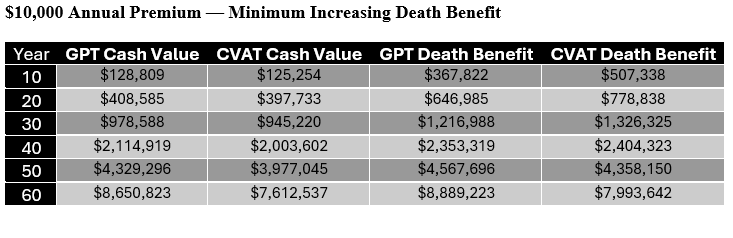
Assume a healthy 40-year-old male, identical investment assumptions and designs optimized for minimum death benefit. In one scenario, annual premiums are $10,000, with the death benefit increasing. GPT produces an initial death benefit of approximately $238,000, compared with $381,000 under CVAT.
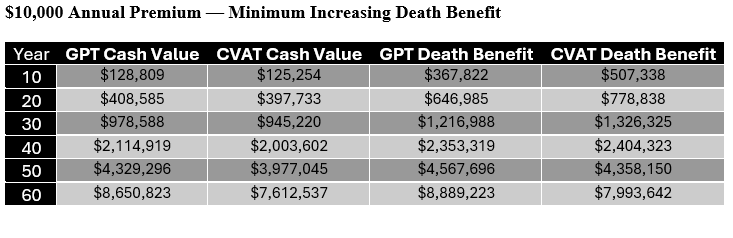
GPT produces higher cash values throughout this illustration. By Year 60, the difference exceeds $1 million.
One might reasonably conclude that GPT is the better accumulation choice. Not so fast.
When CVAT Wins
Consider a different scenario: a $250,000 tax-free IRC Section 1035 exchange into a new VUL policy, with no additional premiums and a minimum increasing death benefit.
GPT requires an initial death benefit of $1,052,775, while CVAT requires only $302,419.
The results are dramatically different.
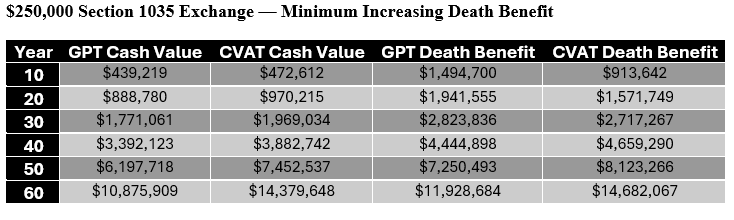
By Year 60, CVAT produces approximately $3.5 million more cash value and $2.75 million more death benefit.
The same two tax tests, applied to a different funding strategy, produce the opposite winner.
The difference between these results would be extraordinary in a traditional investment management comparison.
Future Flexibility Can Change Everything
Return to the $10,000 annual premium illustration. Suppose the policy owner decides, after Year 10, to increase the annual premium to $50,000.
In this particular illustration, CVAT accepts the entire amount. GPT accepts only approximately $13,500 annually.
The GPT design that initially appeared more efficient now imposes a significant limitation on future funding.
Death benefit options introduce another complication. Changing from an increasing to a level death benefit at the appropriate time can reduce unnecessary insurance charges. Continuing an increasing death benefit indefinitely may leave excessive insurance at risk, particularly at advanced ages when mortality charges become substantial.
The optimal year for making that change can vary by design. Furthermore, changes to death benefits can trigger additional tax testing or carrier restrictions.
Unfortunately, policies illustrated with a future death benefit change aren’t always managed to implement it. A change scheduled for Year 15 or Year 20 may never happen because nobody is monitoring the contract.
The consequences can be severe.
Policy Construction Deserves More Attention
These examples aren’t intended to establish that GPT or CVAT is better. They demonstrate how dramatically the answer can change when the funding pattern, death benefit option or planning objective changes.
The correct comparison requires more than running two illustrations. Advisors should examine premium flexibility, MEC limits, death benefit requirements, mortality charges, projected cash values, future policy changes and performance under less favorable assumptions.
Importantly, these illustrations are hypothetical. Actual results depend on product provisions, investment performance, charges, tax rules and ongoing management. Non-guaranteed projections aren’t promises.
The larger issue is that many policy owners don’t even know these tests exist, despite their potentially significant effect on policy performance.
Some illustration systems default to one test without automatically selecting the more appropriate option for the proposed design.
If a relatively obscure tax-test election can change projected outcomes by millions of dollars, shouldn’t we be paying considerably more attention to policy construction?
Life insurance isn’t simply a product to purchase. It’s a financial instrument for design, evaluation and management.
