

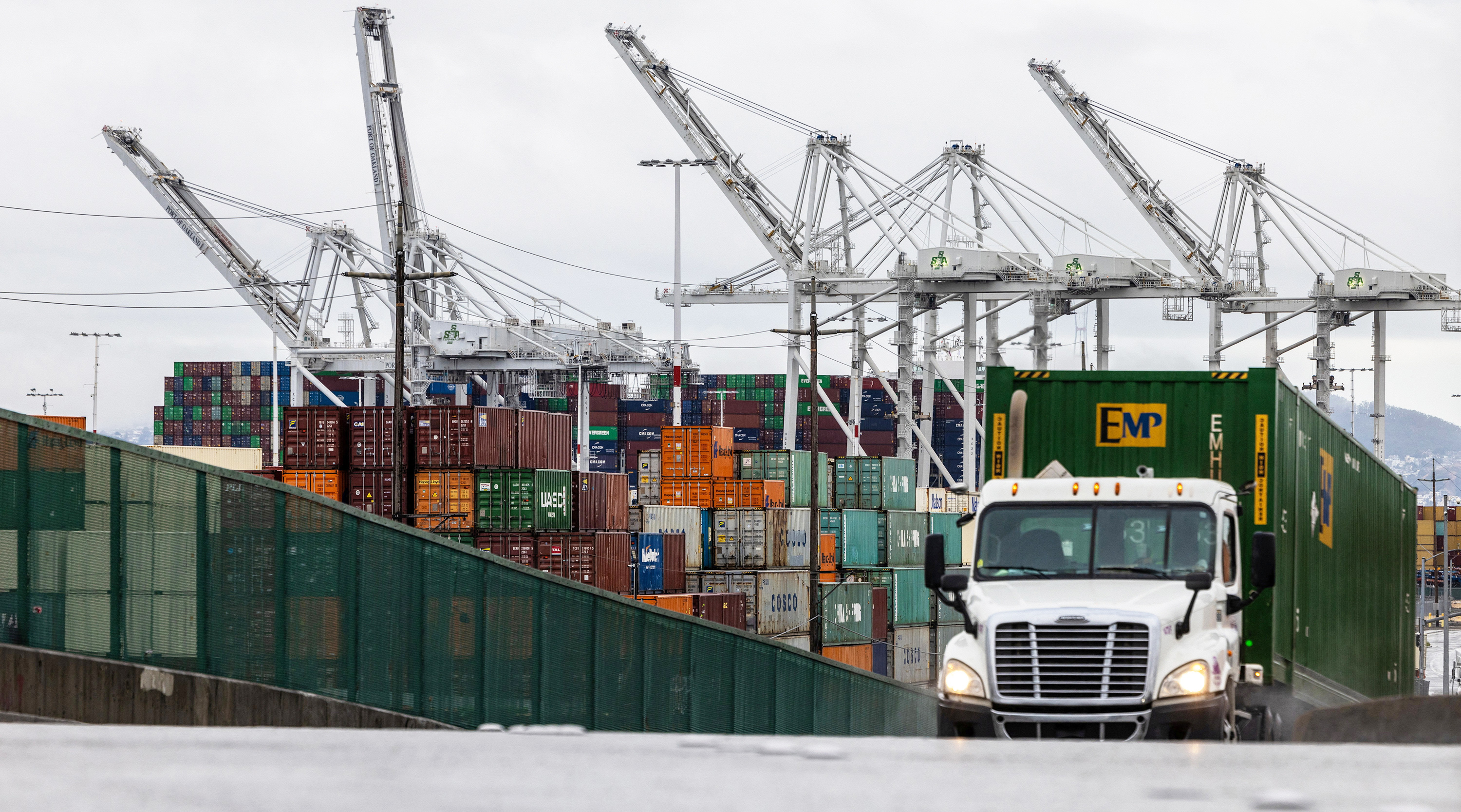
The Trump administration is again shifting its stated rationale for placing comprehensive tariffs on imports of nearly all goods from virtually all countries. After originally presenting such measures as responses to a national emergency and next as remedies for balance-of-payments problems, officials now characterize their latest effort as a tool to press other countries to intensify their efforts against forced labor.
The first two approaches failed to achieve the administration’s objective of lasting world-wide US tariffs, and the third will probably fail as well.
The planned tariffs to combat forced labor, which could start taking effect this week, again raise the question of whether the president has the legal authority to determine and implement US tariff policy—an authority that the Constitution vests in Congress. The answer is no: Congress did not delegate authority of such breadth to the president. It cannot constitutionally do so. These new tariffs would represent another case of presidential overreach. If they were challenged in court, the Supreme Court would likely overturn them.
President Donald Trump first attempted to establish near-global tariffs in April 2025 when he imposed his so-called “Liberation Day” tariffs, claiming authority under the International Emergency Economic Powers Act (IEEPA). The Supreme Court struck them down in February 2026. He then ordered temporary 10 percent across-the-board tariffs purportedly to address a balance of payments problem under Section 122 of the Trade Act of 1974. The Court of International Trade found that the United States did not have a balance of payment problem as specified under this law, and these tariffs expire on July 24.
Foreseeing their expiration, the administration in June proposed additional tariffs of 10 percent or 12.5 percent on goods from 60 economies under Section 301(b) of the Trade Act of 1974, alleging that their governments failed to prevent imports of goods made with forced labor. US officials have signaled they could start rolling out these measures this week. There are more problems with these proposed tariffs than the lack of legal authority. The chief economic downside of imposing a comprehensive tariff is that Americans, whether businesses or end consumers, bear 90 percent of its cost, according to researchers at the Federal Reserve Bank of New York.
Moreover, there is no reason to believe that the proposed tariffs will be an effective means of reducing forced labor abroad. The world has become accustomed to higher US tariffs. There is no evidence that changing the US rationale for them will materially reduce forced labor in other countries.
The tariffs’ design also raises questions about their purpose. Why are the 60 targeted economies divided into just two categories—those with laws addressing forced labor and those without—and then assigned uniform tariffs of 10 or 12.5 percent? The lack of differentiation suggests that the administration’s primary objective may be maintaining global tariffs, rather than crafting a carefully calibrated response to the problem of forced labor. If the goal were genuinely to induce stronger action against forced labor, one would expect the measures to reflect meaningful differences in countries’ conduct and performance on that issue.
Forced labor is already dealt with under US law
The United States has barred imports of goods made with forced labor since 1930. In addition, Section 301 of the Trade Act of 1974 identifies the use of forced labor as an actionable foreign practice subject to the president’s retaliatory authority. There is nothing in US law to suggest that the government should respond to forced labor abroad by imposing secondary sanctions, which penalize one country for its dealings with another. Even the US response to apartheid in South Africa did not rely on secondary sanctions.
The United States is not a party to international agreements that condemn the use of forced labor
The International Labor Organization’s (ILO) Forced Labor Convention, agreed to in 1930, requires the 181 ratifying states to suppress its use in all forms. The ILO Protocol of 2014 to the Forced Labor Convention updates the 1930 convention by requiring member states to take effective measures to prevent forced labor, protect victims, and provide access to remedies and compensation. Some 61 countries have ratified it. The United States, however, has not ratified either of these two conventions perhaps in part because the United States often subcontracts the operation of prisons to private companies which may profit from the use of forced labor.
The World Trade Organization (WTO), which administers the rules of the trading system, leaves countries free to act against the products of prison labor. Following the recent WTO ministerial conference in Cameroon, US Trade Representative (USTR) Jamieson Greer criticized the WTO as “not a serious forum” for global trade governance, specifically regarding global seafood commerce and fisheries. It is true that the 166 WTO members rarely find a consensus for adoption of binding rules and the WTO’s dispute settlement system can no longer issue final determinations. With respect to both shortcomings, however, the United States is currently an important source of the WTO’s ineffectiveness. It has taken the lead in preventing enforcement of the rules and has begun siding with those WTO members who resist agreeing to new rules. It could act differently and work to find support of other sympathetic members for an agreed approach.
What should be done?
The United States, the world’s largest economy, has enormous leverage in its dealings with other countries, as Trump has proved during his second term. Were the nations of the world largely to agree with the United States to address the problem of forced labor for reasons of morality or because doing so is deemed of critical importance to America’s and others’ commercial interests, there would be a fairly good opportunity to engage in negotiations to address the issue. But the United States has not called for the negotiation of an international convention on this subject. Of course, international negotiation would not be useful if the administration’s primary goal is restoring global tariffs rather than acting against forced labor.
Will the courts allow retaliatory authority, under Section 301 of the Trade Act of 1974, never used before in this manner, to be used now against multiple countries to impose secondary sanctions? The use is plausible in other circumstances. It is, after all, tariff authority. It is discretionary. Congress specified forced labor as a target of the statute. Clearly the statute could be used against individual countries that are a conduit for forced labor if there is sufficient adverse impact on the US economy. But Congress has not delegated to the president authority of the breadth claimed by the Trump administration. The Supreme Court is not likely to allow this expansion of the president’s retaliatory authority under Section 301 to substitute for the Congress’ role in setting tariffs generally. The Supreme Court held in February that tariffs were not a tool granted by Congress to the president to deal with a national emergency. For a balance of payments crisis, Congress limited presidential tariff action to 150 days and described requirements for its use. To use the retaliatory authority of Section 301, the acts, policies, or practices of a country must be found to burden US commerce. That requirement is not clearly satisfied for the 60 targeted countries, which account for nearly all US imports and 90 percent of world trade. Additionally, nothing in the history or use of the statute implies authority to levy a tariff against all products from all countries in the form of secondary sanctions.
The Supreme Court stipulated in Loper Bright Enterprises v. Raimondo (2024), that executive agencies cannot interpret for themselves the extent of their authority. It must also find that neither can the president do so when the Constitution provides otherwise. To paraphrase Chief Justice John Roberts Jr., times change, the Constitution does not. Setting broad tariffs is the sole prerogative of the Congress, not the president.
