


Morningstar’s Jeff Ptak recently examined the 100 largest active U.S. stock funds and found something that should make investors pause. The funds, in aggregate, underperformed. However, the failure was not due to their owning the wrong stocks. They lagged because what the managers did after the purchase—trading, trimming and rearranging portfolios—destroyed value.
That distinction matters. Investors often assume active managers underperform either because they are poor stock pickers or because the market is too efficient to allow outperformance beyond what is randomly expected. Ptak’s analysis suggests a more subtle and, in some ways, more troubling explanation: many managers may have had decent ideas, but they failed to let those ideas compound.
Ptak’s method was elegant. He took the holdings of the largest active funds and asked a simple question: What if investors had just frozen those portfolios and done nothing for a year? He compared that hypothetical no-trade portfolio with the actual funds over 2025 and over each of the 10 years ended Dec. 31, 2025. One important asymmetry to keep in mind: the actual funds’ returns reflect their 0.59% average expense ratio, while the hypothetical no-trade portfolio’s returns do not reflect any fund expenses at all.
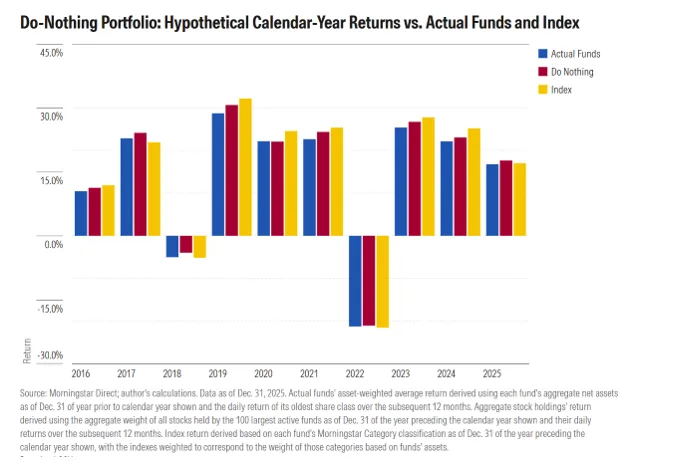
The do-nothing version beat the real-world funds in nine of the 10 years studied. All told, its 14.3% annual return over this period bested the actual funds’ returns by nearly a percentage point. In 2025, a year in which nearly two-thirds of the top 100 active US stock funds by assets lagged their index, the hypothetical approach also outperformed. This was even though the managers had, at least initially, selected stocks good enough to outperform a strong market on their own.
Ptak then calculated the performance of a more extreme hypothetical portfolio, freezing the collective holdings of the 100 largest U.S. active funds as of Dec. 31, 2015, and leaving them untouched over the subsequent 10 years. What could be called his “Rip Van Winkle” portfolio returned 15.2% per year over the 10 years ended Dec. 31, 2025, topping the asset-weighted average return of the actual funds (13.8% annually) and surpassing the index’s 14.9% annual return as well.
Supporting Evidence
Ptak’s findings are consistent with those of Klakow Akepanidtaworn, Rick Di Mascio, Alex Imas, and Lawrence Schmidt, authors of the 2021 study “Selling Fast and Buying Slow: Heuristics and Trading Performance of Institutional Investors.” They found that even sophisticated institutional investors struggle with exit decisions despite being skilled at entries. They explain: “Evidence suggests that an asymmetric allocation of cognitive resources, such as attention, can explain the discrepancy.”
The evidence should change how investors judge active management. If the managers owned the right stocks but still trailed, the problem is not just stock selection. It is a process. It is turnover. It is the hidden tax of acting on every new idea, every urge to “improve” a portfolio, and every other behavioral impulse.
For investors, the lesson is straightforward. Good stock selection is not enough. A manager must add value after costs, after taxes, and after trading frictions. That is a very high hurdle, and most actively managed funds do not consistently clear it. In fact, the research (including Eugene Fama and Ken French’s 2010 study “Luck versus Skill in the Cross-Section of Mutual Fund Returns”) shows that only about 2% of actively managed funds outperform on a statistically significant basis—less than would be randomly expected.
Lesson Learned
The evidence reinforces the point that indexing’s advantage is not merely lower fees. It is also behavior. Index funds avoid the costly mistake of trading too much, too often, and too confidently. With that said, index funds are not a silver bullet. My September 25, 2025, Morningstar article, “The Hidden Costs of Passive Investing,” showed that index funds and systematic strategies face trading frictions that quietly erode investor returns. In addition, my June 16, 2023, Alpha Architect article explained that there are drawbacks to indexing that can be minimized or eliminated through intelligent design.
The Bottom Line
The next time a fund company highlights a manager’s best ideas, ask a harder question: Did those ideas survive implementation? Morningstar’s analysis suggests that for many of the biggest active stock funds, the answer is no.
