

A year ago I wrote the blog post Why I’m Bearish on U.S. Stocks (for the Second Time Since 2017). Since then U.S. stocks are up 16% (total return) and my bearish prediction turned out to be misguided.
So where did I go wrong? And how can you prevent yourself from making the same kind of error in the future?
This Time is Different (When Overfitting Fails)
A year ago I saw a few signs that reminded me of the 2021 market exuberance:
- Chamath Palihapitiya was filing for a new SPAC
- Meta was paying $250M+ to hire individual AI researchers
- The S&P 500’s Price-to-Sales ratio was back near an all-time high
As I stated, “It’s not that any one of these things represents a mania, but collectively they do.” While there definitely is some mania around AI, each of the signs I focused on ended up being less significant than I originally believed.
First, Chamath launching a new SPAC isn’t a sign of anything. He is going to do what’s in his best interest, regardless of what the rest of the market is doing. If he can find a way to cash in, he will, whether it’s crypto, AI, or something else.
Second, Mark Zuckerberg has been known to “overpay” for things today only to look like a genius in hindsight. I remember when he bought Instagram for $1 billion and many thought he was crazy. Looking back now it’s arguably the best acquisition in business history. The fact that he paid a few billion dollars for the world’s best AI researchers is another such bet that I weighed too heavily. This is what Zuck does. We will just have to wait and see if it pays off.
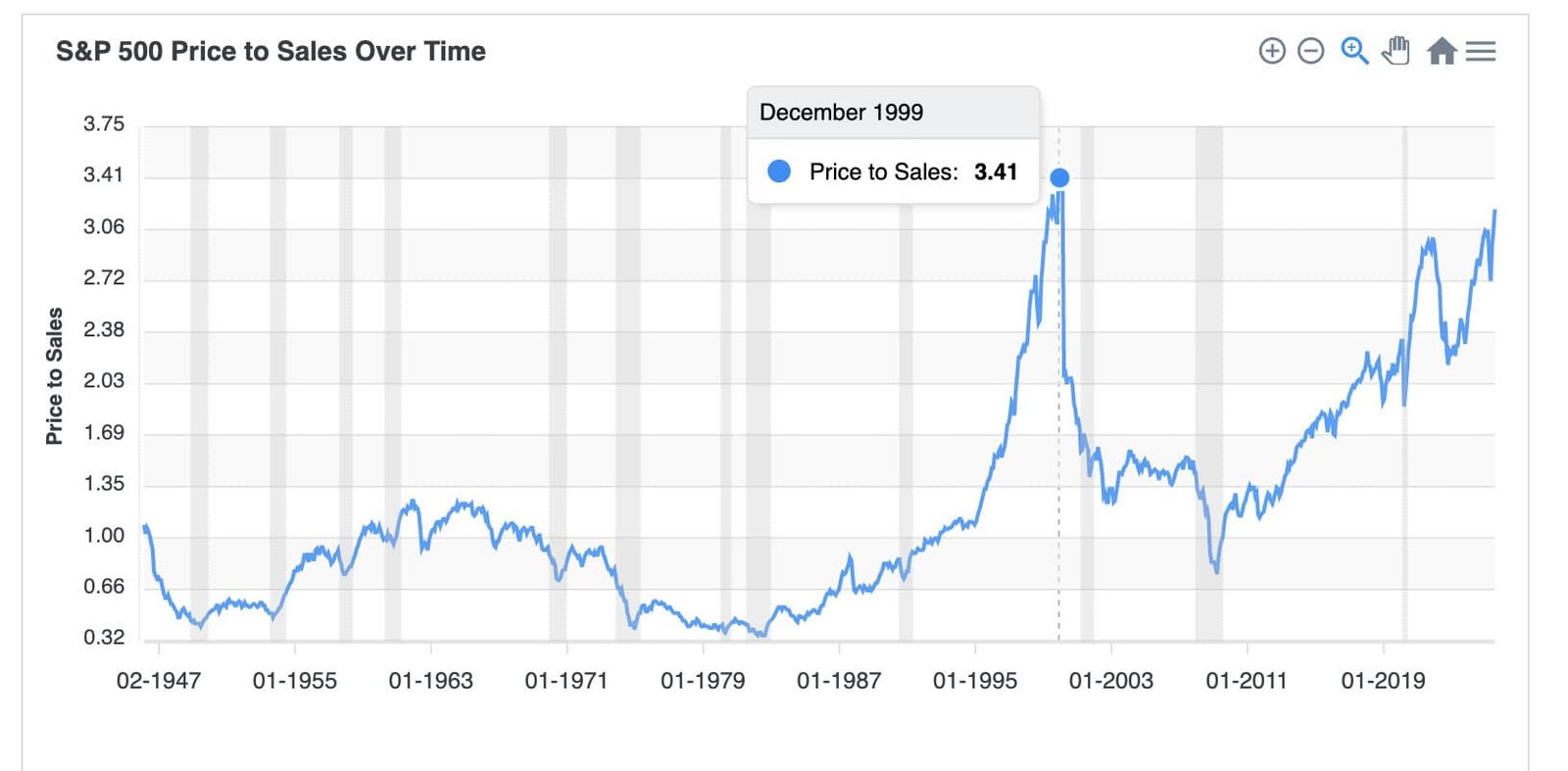
Lastly, sometimes your data is wrong. Below is the chart I posted a year ago of the S&P 500’s price-to-sales ratio going back to the 1940s (from DQYDJ.com):

As you can see, the P/S metric peaked at 3.41 in 1999. After seeing the run-up in the ratio in 1999, in 2021, and again in 2025, I concluded that we were in bubble territory.
Unfortunately, this data series was inaccurate, but I didn’t know it at the time. I’m not sure exactly what changed in how the data was constructed. What I can say is that the revised series matches other sources I’ve cross-checked.
If you go to look at the price-to-sales ratio of the S&P 500 today on DQYDJ.com, the 1999 peak is now around 2.09 (instead of 3.41):

This chart tells a very different story. When the P/S ratio passed 2.09 (the 1999 level) in 2017, market conditions weren’t anything like those during the DotCom bubble. No one thought there was the same kind of froth in 2017 as in 1999. And the ratio has kept climbing since, to around 3.5 today, without any accompanying DotCom-style implosion. Therefore, the only correct interpretation of the P/S ratio over the last decade is that it doesn’t signal what it used to.
I’ve made this argument before when discussing the problem with valuation metrics, especially the P/E ratio. It looks like the same argument can be made about the P/S ratio too. Since many of today’s companies have higher margins, the aggregate P/S ratio can rise even as companies remain fairly valued.
I don’t blame DQYDJ.com for the data mishap. Corrections get made all the time. I get it. It’s no one’s fault. But if I had the correct chart above (instead of the incorrect one), it would have given me pause. Of course, it’s possible that I would’ve overlooked this and found another piece of evidence to confirm my theory, but it’s difficult to say.
Either way, I learned a valuable lesson from my failed bearish prediction a year ago—it’s easy to overfit the data. If you want to find parallels between one period (2025) and another (2021), you’ll be able to. You can find opinion pieces, charts, and investor behavior that are similar across any two periods if you look hard enough.
My issue wasn’t that the parallels didn’t exist—they did. My issue was that much of the speculative stuff of 2021 ended up failing (NFTs, DeFi, etc.) while much of the speculative stuff of 2025 (AI) seems to be succeeding. I pattern matched the frothy behavior and concluded that the result would be the same. But I was wrong.
The best example of this is Anthropic, which had a revenue run rate of around $5 billion in July 2025 (when I first got bearish). This was up from $1 billion in January 2025. Its growth was incredible, but it couldn’t continue, right? Wrong. As of late July 2026, Anthropic’s run rate was estimated at $74 billion, or about 15x higher than a year prior.
I know Anthropic is an outlier and run rate isn’t the same as profit, but the company’s meteoric rise illustrates why this time is actually different. The growth is happening, the models are getting better, and more people are using AI. Note that this is evidence about AI adoption, not market-wide valuation. A private company’s run rate tells you little about whether the S&P 500 was fairly priced or whether future stock returns will be positive. But it does highlight why I got the direction wrong a year ago.
Of course, this isn’t the only reason I was mistaken. Because I also forgot one of the oldest and most consistent lessons about markets and life.
Respect the Base Rate
In February 2021, I wrote a post about base rates, or the probability of an event occurring without having any other information. For example, if you flip a coin, the base rate of it landing on heads is 50%. If you later found out it was a trick coin and the probability of heads was 75%, then your base rate of getting a heads would become 75%.
This concept is important because the base rate for U.S. stock performance (in aggregate) over one year is that they go up. In fact, historically they went up in 7 out of every 10 years (and around 9% in any given year). This was true when things looked bearish, bullish, and everything in between. This doesn’t mean that they never went down. It doesn’t mean that you can’t lose money. It just means that, statistically, the most likely outcome for U.S. stocks is that they go up.
And that’s what happened over the prior year. Unfortunately, I forgot to respect the base rate. Hopefully, I won’t make that mistake again.
Instead of trying to time the market or “sin a little” (as Cliff Asness would say), it’s better to have a portfolio that can handle stocks whether they are overvalued or not. Because if you can’t handle standard market cycles, then you don’t have a portfolio, you have a bet. And bets are great when they work out, but can be brutal when they don’t.
For this reason, I haven’t changed my allocation in response to the last year. I’m still 80/20 in my 401(k) instead of 100% risk assets. Being wrong cost me about 4% in that one account. A financial paper cut.
And while I made that allocation change for the wrong reason (my misguided bearishness), with a growing family, it ended up being the right allocation for where I am today.
Ultimately, I don’t need to be right about the market. I just need to survive whatever it throws at me.
Happy investing and thank you for reading!
If you liked this post, consider signing up for my newsletter.
This is post 517. Any code I have related to this post can be found here with the same numbering: https://github.com/nmaggiulli/of-dollars-and-data
