

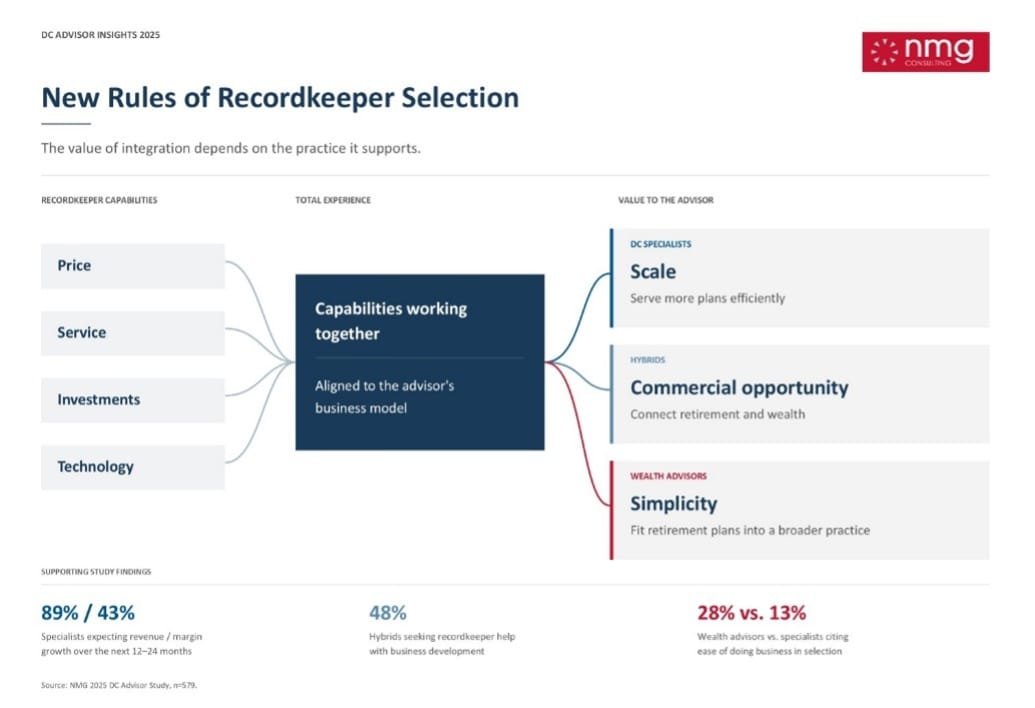
I’ve spent more years in and around recordkeeping than I care to admit. In that time, the industry’s language for winning advisors and new business has barely changed: price, service, investments, technology. Check the boxes, and surely success will follow. But a proposition built for the average advisor risks being compelling to none. To be successful today, record keepers need to decide whom they want to serve and build their offer around how those advisors are building their practices.
NMG’s annual DC Advisor Study of nearly 600 advisors confirms these criteria matter, but suggests strong capabilities alone do not secure placement. A record keeper’s value increasingly depends on how well they support the advisors’ business models.
Consider two record keepers with the same 77% advocacy score, one with leading service ratings, the other with a leading digital experience. Between 2024 and 2025, their shares of top-3 advisor relationships moved in opposite directions: one fell from approximately 30% to 22%, while the other rose from approximately 25% to 28%. Record keeper advocacy measures regard; it does not solely establish whether it will win the advisors’ next plan.
Advisors experience record keepers through the daily running of their businesses. Prospecting becomes a sale, then implementation, and ongoing service. A participant question becomes a planning opportunity or an administrative headache. A record keeper can perform well within each function while leaving the advisor to manage the gaps.
Evaluating capabilities in isolation, therefore, misses something essential. Service depends on access to information. Technology connects the relationship, creating efficiency, delivering insight and helping advisors act. What matters is how well the capabilities work together.
The reason this matters more today is economic. Advisors once commonly received at least part of their compensation through record keepers. Today, particularly for specialists and hybrids, compensation is more likely to come directly from the sponsor. Record keepers increasingly influence the cost of running a practice: service problems consume staff time, poor integration creates work and efficiency creates capacity.
Price still matters. In our study, 80% of advisors cite pricing as a selection criterion, and 68% cite client service. Yet poor advisor service is the leading reason for not doing business with a record keeper, averaging 28% across record keepers, versus 8% for fees. Price gets a record keeper onto the shortlist; poor service knocks it off. A low fee for the plan sponsor can still leave the advisor with a costly relationship to manage.
Record keepers can also help practices grow. Better connections between the record keeper, advisor, TPA and client can reveal participant needs and plan opportunities. Forty-three percent of advisors identify business development as an area where record keepers could better support them.
What that support should look like depends on the advisor’s business model.
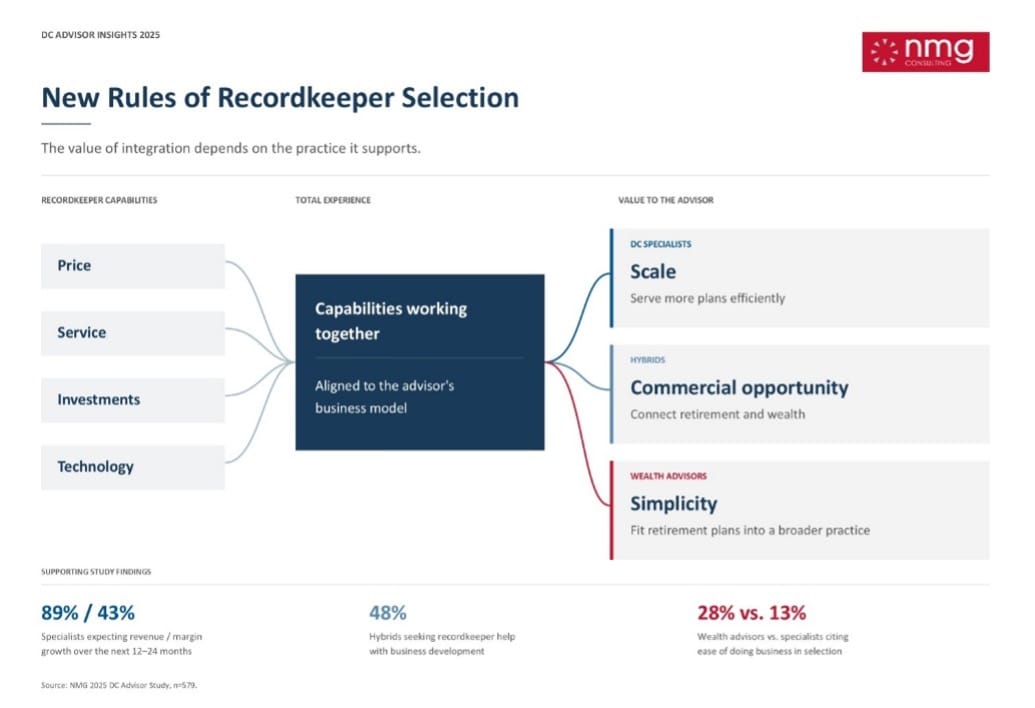
For DC specialists, the priority is capacity to scale. Eighty-nine percent expect revenue to increase over the next 12 to 24 months, but only 43% expect gross margins to improve. Serving more plans without comparable staffing increases can help close that gap. At their volume, service failures quickly become capacity problems.
For hybrids, the opportunity is connecting retirement and wealth. Nearly half want more business development support. Participant information and engagement can help identify advice needs and build broader client relationships.
For wealth advisors, the priority is simplicity. Twenty-eight percent cite ease of doing business as a selection criterion, compared with 13% of specialists. Retirement plans must fit within a practice focused elsewhere, without requiring the advisor to become a retirement expert.
Across practices, the best experience is not purely digital. Thirty-seven percent want greater support through dedicated contacts. Advisors want technology to simplify routine interactions and someone accountable when problems arise.
Price, service, investments and technology remain essential. The new rules concern how record keepers combine them for the advisors they choose to serve: capacity for specialists, commercial connections for hybrids, and simplicity for wealth advisors. Checking the boxes may earn consideration. Earning the next plan depends on making the advisor’s business work better.
